Words to move life…and so create less suffering
Some of this information may have come from Tai Sophia program around 2002.

The Jewel Tree of Tibet: The Enlightenment Engine of Tibetan Buddhism by Robert Thurman
Notes from listening to the tapes…
First Scale in the arpeggio: To the Mind of Transcendence (Self-release) Four notes.
1. Appreciate our precious human life endowed with freedom and opportunity..
2. Death — impermanence — don’t know when. Open spiritually to the possibilities of the moment.
3. Inexorable causality — infinitely flowing from past through present to future. Each moment is intinitely pregnant with potential.
4. Inadequate state of suffering (samsara) of ego-centric self state pitted against the over-whelming odds of the universe of “others.”
The Mind of Transcendence removes the pressure of needing ot accomplish. Provides relief.
Second Scale in the arpeggio: The Spirit of Enlightenment: Mind of Love and Compas sion for All Beings. Five notes.
- Equanimity — friends, strangers and enemies. These are as they are mainly from how they have repeatedly interacted with you. They have switched positions over the eons.
- Recognition of motherhood of all beings. Infinity of interconnectedness of all beings.
All have been our mother in the infinity of past existences in the continuity of spirit. No
beginning. No end. No First Cause. - We remember the kindness of these mothers and have Gratitude.
- We repay that kindness wherever they are. We want ot be the mother of their re-birth into infinity-hood.
- We become concerned for them — not our self preoccupation. We choose other preoccupation.
Third Scale in the arpeggio: The Quest of Liberation: Mind of Transcendent Wisdom. Self-lessness of subjects/persons- subjective.
Self-lessness of objects – – objective
Five Notes
- Look ot see what our self would be during righteous indignation. Notice the solid sense of presence. I’m the one. I exist.
- If we look with all our effort and the absolute, separate essence of Self doesn’t exist, then we will admit that.
- Look for unity of ”solid self” and life systems. Find a state of floating free — relative existence.
- Look for solid/absolute self as a process. There is no “tableness” in a table. All dissolves under analysis.
- Space/Nirvana. Emptiness is like the reflection of a mirror — not real. No ultimate state. Stop seeking escape from relational states. Relative states are the absolute state
Freedom is the womb of compassion.
Tibetans and Buddhists were the supreme knowers of nature — done through internal means — rather than external means
(microscopes, atomic energy, etc. like Western scientists). Self-lessness — no absolute self — instead we have a relative self which is the product of our imagination and the imagination of the world /others.
Realization of self-lessness (emptiness). We have an instinctual miss-learning that “I m the one…
This can’t be dislodged by spacey meditation of not thinking. It is an unconscious self-habit and self-knowledge. We add many more layers of “I’m the ______ (man, father, fat, poor…) on top. The whole structure begins to appear to have absolute substance and reality to us.
Royal Reason of Relativity
All things are empty of intrinsic/absolute essence, because they are a relative — since we relate to them.
Absolute has no limits or boundaries. It is infinite. [In physics, “absolute” is only a subjective view point from the self- observer. All other viewpoints are relative to the observer.]
How do we reconcile the different viewpoints?
- Intrinsic “knowing” that “I” am absolute versus
- The logical observation/learning that I am only relative. Through meditation:
- Shamata one pointedness focus/concentration. Shutting off internal dialogue. Instinctive self remains.
- Vipasana — like a koan — dislodges self-centeredness. Merge the feeling of intuition (self-centeredness) with the critical relative-self — using concentration until the self-centeredness is broken through. Drill down with the focused concentration.
Science once was a branch of philosophy studying the Na- ture ofreality.
Vow of Bodhisattva
I dedicate my life/existence to reaching buddhahood so that I can bring all sentient creatures to buddhahood and out of suffering.
Non-duality: emptiness,relativity
Duality believes in a separate state (Heaven, etc.) where the Absolute Self can hide safely from the pain of relationships.
Reality is freedom, bliss. Keep looking deeper to see and know it.
Mirror wisdom — seeing “crap,” we see freedom and bliss.
Tantra means continuity. Once you have demolished the world of absolutes based on ignorance, critical wisdom moves to develop a world shaped by wisdom — a world with optimal opportunity for each being to develop.
To rebuild the world of wisdom, we need the Mind of Transcendent renunciation. Recognizing the infinite continuity of life and appreciating my human sense of that life.
Our only enemy in the world is our feeling of a solid, absolute self. Dethrone that master by understanding that no absolute thing can be experienced by any relative thing. Any sense of person that I have is relative only — therefore it is constructed — made up of experiences. Infinitely transformable, malleable. Impermanence. I am never stuck in any sense of self. We imagine our selves and can do so in creative new ways — moment by moment.
“Death” = un-intwining the soul from hte absolute self. Can be done often with lucid dreaming, imagination, etc. in one physical lifetime. [Apostle Paul said ” I die daily.”]
The intersections of the imagination of sentient beings are what shapes reality. Once everything is void, “nothing” does not exist — and those things that exist are shaped by mind.
Mind is channeled in shaping things because its not a single subjective mind — it’s an inter-subjective mind of many beings. These shape the world through language — through the Word. Mantra — magically gives Form to things.
People feel trapped in “prisons” of steel made of habits and absolutes/ignorance (“that’s just the way it is.”) when they are really only within a bubble of bliss.
Tantric States of Consciousness
Buddhas can consciously build everyday forms from these deep levels.
Transparent light; Dark light; Sun light; Moon light; Candle Flame; Firefly or sparks; Smoke; Mirage/hallucination; form in ordinary reality
These levels are described in the Tibetan Book of the Dead as levels we move among.
Tibet does not revere ancestors since “to them” there are no dead. My deceased uncle immediately became someone else
— someone I may meet on the streets. Thus reverence for ancestors is transmuted into reverence for fellow humankind.
Om mani padme hum
Tibetans pronouce:
Ome mah’ nee pay may home
This mantra sends relief up and down as needed. To the hells
of heat, it sends cooling. To the hells of starvation, it sends food. Etc.
Shaking out the Spirits by Bradford Keeney
I saw the cross as the whole pattern organizing one’s relationship to the spirit world. Like Jesus, one should be stretched
across all polarities, including good and evil. In this way, Jesus accepted our sins rather than negating or destroying them.
Healing, too, is not about eradication of evil, sin, sickness, illness, or pathology. It is about embracing sickness as a corner of the cross one carries. Accepting it as part of this sacred whole carries with it a resignation of one’s individual will and surrender to the greater purpose of the Greater Spirit. Healing involves the re-contextualization of a person into the sacred context, placing them in the middle of the four corners of the cross. Within the sacred, holy, or whole of the cross, a person becomes healed, that is, made one with the Great One.
Here, the particular outcome of one’s life is less relevant. One is ready to live and ready to die. At this point in the center of the universe, it is always a good day to die and a good day to live. page 110
[Credo Mutwa] spoke of the stupidity and dangers of psychiatric nomenclature and the necessity to always cooperate with the symptom.
Naming a problem feeds its power, he said. In his culture, problems aren’t even discussed. This would empower them and make them more difficult to alleviate. A new breed of healers will be required for the troubles and plagues that increasingly confront us. These healers will be disconnected from the medieval cruelties of psychiatry and medical-minded psychologists with their lobotomizations of the connections between mind, body and spirit. Armed with the understandings of ecology and relationship, these systemic-minded healers will utilize (rather than attack) people’s symptoms and problems and help them move forward with their lives without psychiatric testing, assessment, diagnosis, medication, hospitalization, and economic ruin.
In the world of killer plagues, these healers will teach people how to die. They will show how death is a door to life. Only in learning how to die can people learn to live. To accept death is to walk the spiritual path. This same path is the only route toward life and the survival of our whole ecosystem.
AIDS may not have come to extinguish the human race, but to help save it. If it helps teach us how to die through turning us toward spirituality, it is a blessing. Of this we can be certain: the future, if there is to be one, can only be realized if we become spiritual. Conquering nature through consuming, curing and taming it, has been the very process of our own destruction. Accepting our humble part in nature through cooperating with other living creatures and accepting the mysteries of the wild will be our only healing.
The new breed of healer will reject the seductions and lies of convenient recipes and schools of therapy cooked up by modernist hucksters. They will submit themselves to the wisdom of the old ways. Spirituality, rather than economics and professionalism, will organize their practice.
Stewardship, service, and sacrifice rather than exploitive profit, pseudoethical guidelines, and self-serving guilds will characterize their contributions. These new healers will not be professionals. They will be human beings.
The forthcoming age of healing will de-emphasize curing and accentuate healing, the making whole of one’s place in the universe. In this new healing age of wholeness, all the directions will intersect. The bringing together of different spiritual traditions can wait no longer. In the sacred center point, the cross and the dance become inseparable. Here one is healed to move and moved to heal, becoming nothing and everything. Here one finds the fire of shaken spirits. Page 126-7
The great traditions of shamanism, with their emphasis upon direct communion with the spirit world, teach us that the boundaries imposed by religious institutions and their texts are artificial. Siberian shamans may commune with the Virgin Mary, Native American medicine people may converse with Christ, and Christian shamans may fly with the eagle. There is a sacred circle connecting everything that is holy. Independent of which tradition one enters, the ascents and descents of an impeccable spiritual journey will always lead one to that center point of great stillness. There the strongest medicine of earth, love, will break our hearts and open our minds to be free of our own self-imposed limitations. There we surrender and die to be reborn to the hope that a meaningful life is made through the action of being a good steward. We truly receive all we need when we give all we have. That is all we need to know.p. 161
An Evocation of Mystery
The black snake must re-enter the belly of the body that has Christ-Eagle in its heart. Only in this spiritually whole body can the middle point between good and evil be found. Here one does not indulge in either evil or good. Indulgence is possible only if there exists a “self” available to indulge. Being good or evil implies the presence of such a pursuing agent. The experience of evil or good feeds the realization of the reality of this self. The death of self leads to a complete absence, a place of nothingness. Here there is no entity or identity that can indulge in good or bad.
The loss of self occurs when one is stretched across all sides of spiritual opposites. This crucifixion on the cross of all opposites leads to the death of self and the birth of being, spiritually, in the center of nothingness. To give everything away — property, ideas, longings, and even one’s life as one knows it — is to find that there never was a self to begin with. The emptiness of one’s core had simply become filled with the litter of concretized ideas. When all that garbage is disposed of, there is no self to be found. The idea of a self was an illusion. believed in because it was assumed all the stuff must have belonged to someone, namely one’s self.
The re-birth of being in nothingness makes all spiritual gifts possible. In this middle spot of the cross of opposites, the energy of life and death may move as freely as the leaves blowing with the wind. Here the natural world enters, not the world of decaying garbage. The winged ones, the green ones, the four-leggeds, mountains, streams and clouds may fill this emptiness. In this way the outer natural world fills the space of one’s inner world. Dreams are the guide to this new way of filling the internal emptiness. What one is shown or told in dream must be found in the natural world.
When it is found, the outer and the inner become one. In this way our inner ecology unites with the outer ecology making the distinction between the two possible. When this takes place we move more toward a oneness with the whole natural world. We become all of our relatives. Knowing that the inside is one with the outside enables us to be in the outside with complete awareness. In this way we surrender our limited mind to become a part of a Greater Mind. This Greater Mind constitutes the mind of healing.
In the Gnostic Gospel of Thomas (Pagels, p. 124), Jesus discusses this: ”When you make the two one and when you make the inside like the outside and the outside like the inside, and the above like the below, and when you make the male and female one and the same…then you will enter (the kingdom).”
Through sacrifice and the death of the unnatural world we empty ourselves of our self. The natural world is then reborn into us through our dreams. In dream time we set forth on journeys to bring the outer into the inner. The passages across this boundary are the passages into shamanic experience and healing. This boundary or crack between the inner and outer world becomes deeper and wider with every crossing until one day the space in the crack has become the whole. This whole space or emptiness that once separated the inner from the outer becomes the complete emptiness that now embraces the whole natural world.
Coming home to the heart of this great, holy emptiness requires our fullest surrender and participation in shaking out the spirits. The spirits are the guides directing us across the inner and outer interfaces. They exist in the midpoints and provide a “medium” for the processes of transformation. The spirits also cross the interfaces and return over and over again to the Center of the Great Circle embodying everything and nothing. We must help them, as they help us, in being shaken out and moved toward the Center of the Great Circle of Healing. p 163
My own experience of the spiritual world begins with my feeling spiritual energy or vital life force. I refer to this energy as “spirit” or “spirits.” It’s called “prana” in India, “mana” in Hawaii and Indonesia, “ki” or “seiki” in Japan, “chi” in China, “num,” “ngai,” “nye,” “nzmbi,” and ”voodoo” in Africa, “maxpe” by the Crow, “wakan” by the Dakota, “upa” by the Hidatsa, “manitou” by the Algonquian, “jojo” by the Australians, “petara” by the Dajak of Indonesia, “tandi” by the Batak of Sumatra, “hasini” by the Malagasy, “baraka” by Sufis, “yesod” by Jewish cabalists, “ruach” by the Hebrews, and “the Holy Spirit” by Christians. I believe these different names refer to the same source of spirit that is open to all, regardless of knowledge, background, color, culture, gender, or religion.
When one receives spirit, whether in the form of a vision, a song, an idea, a dance, or whatever, one is obligated to act. To fail to transform it, is to risk having its energy degenerate into unhealthy forms. Edgar Cayce gave a reading in which he said, “to know, and not to do, becomes sin.” Evil is stagnating, untransformed spiritual energy. Good can be made from evil when its energy is transformed. P 170
Humor brings us back to who we are — fools, idiots, and buffoons. Our experience of the gods takes place because we remove our selves to allow the spirits to use us.
When we return, the gods leave and our body is again inherited by a spiritual idiot. Once, upon hearing a remark about his prodigious spiritual gifts, Edgar Cayce commented that when he’s conscious, he’s merely a below average human being. This humility is not an exercise in being modest about our greatness, it is a realization of our being nothing. P 171
The wild is one of our greatest healing and teaching resources. // In the wild, the meaning of any particular piece of action is minimized by the larger, more encompassing dance of interrelatedness performed by all living organisms.
Here the whole context of one’s experience more easily becomes the focus, rather than the isolated experience. In the wild all participants are more easily realized as small, rather inconsequential players in the whole. The wild, like a sweat, levels one to the ground. If one fully accepts this leveling to insignificance, an abandonment of self takes place and unity with the wild is possible. One accents one’s part in nature and thereby becomes one with nature.
In the wild, being impotent with fear or being outrageously macho are the same. Both ways of being exaggerate and focus on the importance of self. The courage to both act for life as well as accept one’s possible immediate death is a more accurate description of how one should fit into nature.
Nature is not a stage on which we perform. It is a body of which we are a part. Our hand is not an independent actor performing on the stage of the rest of our body. It is a part of our whole body. Speaking of them as separate is insane.
Using our hand as if it were separate from the rest of us is potentially dangerous. To reconcile our relationship with nature requires acting upon the recognition that we are not separate from it. The hand which is us must be reconnected to the body of nature. p 172
Healing is fundamentally about connecting hands and other parts back to their bodies. It is not about alleviating or curing localized pains and discomforts, although that may be a consequence. Healing, the process of making whole again, is a way of leading people back to contexts which connect them. It should be no surprise that wilderness areas are often the most appropriate locales for healing, p 173
Throughout all cultures of the world, people have found different wavs to activate and utilize the flow of life energy to help others be restored and renewed. A fully developed spiritual life moves with these flows of energy, striving to have every breath of life be realized as a full participation in the vibratory movements of spirit.
It follows that all sources of vibration and movement have potential for healing. The creation of difference and the rhythmic movement across the border of a difference constitutes a vibration. Any given vibration may move through other differences creating a flow of vibrations. The major pathways of such a current move through stations and centers where focusing, amplifying, and transforming take place. Healing. from this vantage point, involves creating differences, creating vibrations (movements across the sides of a difference), and opening up currents of vibration. p 174
For me, love for another without any purposeful glorification of self and without fear of evil constitutes the lens focusing spiritual energy for healing. Love untainted by fear, control, judgment, possession, and expectation is raw, vibratory, life energy, the energy that fills another with life.
It transcends ideologies and social structures and is available everywhere. It is not bought, earned, deserved, or achieved, but free for those who sincerely ask.
From this perspective the life energy available for healing is free from being owned (or possessed) by any religion or spiritual practice. Life energy may arise in a classroom, a camping trip, in a concert, play, sporting event, conversation, quiet meditation and sometimes even in a church!
It’s hard for some religious people to accept that the spirits don’t exclusively reside in religious structures. They are free to roam wherever sincere hearts call. It is as possible for the spirits to reside in the music of a jazz saxophonist in a sleezy bar as it is for the spirits to be absent in a high mass at a cathedral.
When religious worship services and sermons get into judgmental trips or displays of piety, the spirits quickly vanish and the church immediately feels like it has lost its soul. At such a time, the most spiritual thing to do may be to ignite a rippling of belly laughs. Then, the holy spirits may decide to return. When the spirits return, they are available to move people. Connection with the flowing currents of spiritual energy connects one more to all of life. In this connection to the great current, river, and ocean of life’s vital force, we are healed. Here one is moved vibrated. and even shaken by the tides of a great ocean of healing. p 175
Improvisation
Medicine men – the herb healers as well as our holy men — all have their own personal ways of acting according to their visions. The Great Spirit wants people to be different. Following one’s own visions and listening to what the spirits tell you are the main teachings one needs.
When we attune (or heal) ourselves to our rightful place (no more and no less than that of any other living creature), we become fully connected and related to all our relatives. Here we are able to commune and learn from all creatures. p 176
Getting our being to where it belongs requires freeing ourselves from the contrivances and manipulations of abstraction and thought. Naked mind is different from dressed mind and the former enables us to directly encounter the naked minds of all creatures. As Joan Halifax says, “For the shaman the world of creatures is the uncontrived, the uncooked, the raw: it is the realm where thought does not interfere.”
The purpose of the trials and tribulations of spiritual journeys is to help trip one into falling into this raw, naked, natural way of being. Richard Baker-roshi: ”Enlightenment is an accident. Practice makes you accident-prone.”
Something has to break inside of you; and then that which is discovered within is found to be raw and absolutely naked. It is a mind that some people know who leave no tracks on their way. It is rare, and it is cultivated in the wilderness. p 177
Note: Lakota “Big Race” involves the stars: Castor, Pollux, Procyon, Sirius, Rigel, Pleiades and Capella
Chinese Medicine for Maximum Immunity [I’m Unity] by Jason Elias, L.Ac.
The Chinese believe that the Five Elements –Wood, Fire, Earth, Metal and Water — govern the physical, emotional, and spiritual existence of human beings just as they regulate the cycles of growth and change in the external world. An excess or deficiency in any one of these basic forces immediately and powerfully affect your physical health and emotional well-being. Once you learn how to balance these energies, regulate their flow, and adjust any excesses or deficiencies, you can create health and harmony in your life.
Each of the Five Elements has a unique nature and spirit, and every human being has a constitutional affinity to one or more of them. The aggressive, forceful energy of Wood is most obvious in the season of spring, when the buds swell to bursting and the seeds sprout into tender shoots that, against all odds, push their way through the earth to burst into vigorous life. If Wood is your predominant energy, you are like the greening stem of spring, driven by the need to stay in motion and reach to new heights, yet firmly grounded by a sense of self and “home” — the place where you fit and belong. Your roots are driven deep; your potential is unlimited.
The radiant energy of the sun, which is the power of Fire, is felt most intensely during the season of summer. Fire is the force that generates passion, compassion, and creativity. If you are energized by Fire, you are filled with enthusiasm and a blazing love of life. You draw others to you as the flame draws the moth, and you thrive on drama and excitement. Your intense craving for affection and close physical relationships will prove to be either your greatest strength or your most notable weakness.
The power of Earth is captured in the image of a garden: fertile, nourishing, solid, yet forgiving, the power of Earth is strongest in late summer and early fall — harvest time. If you are energized by the power of Earth, you are a natural mediator who thrives on harmonious relationships; discord and dissension throw you off balance. A sense of kinship and connectedness to others is essential to your health and happiness. Earth energy helps you find a center between opposing forces, teaching you how to resolve your differences and find sensible solutions to even the most difficult problems.
The power of Metal is symbolized by a majestic, snow-capped mountain. Reaching toward the heavens, yet firmly grounded in the earth, the mountain stands as a symbol of inner strength, endurance, and tranquility. If you are energized by Metal, you are disciplined and precise, strong-willed yet willing and able to adapt to changing circumstances. Drawn to the core issues of life and the higher truths of art and philosophy, you seek to develop your character by devoting your attention to ethics, morality, and the acquisition of knowledge. Your season is autumn, the time of year when you begin to compress and contract your energy, pruning back and pulling inward in preparation for winter.
The power of Water, which is most evident in winter, can be seen in the raindrops that freeze overnight into icicles and melt in the morning, falling softly to the ground to dissolve into mist when warmed by the sun. Water changes shape effortlessly and yet never loses its essential character. If Water energizes you, you are dependable, infinitely resourceful, and single-minded in pursuit of your goals. Difficult or demanding situations do not cause you to hesitate or retreat, for you have a firm, unshakable sense of self, and you follow the path before you with strength, purpose, and determination.
Each of the Five Elements interacts in unique patterns and cycles to create your individual personality, emotional responses, spiritual desires, and physical strengths and weaknesses. When one power is excessively strong or weak, specific physical, emotional, and spiritual imbalances may occur. Excess Wood energy, for example, can lead to aggressive behavior, impatience, explosive anger, arrogance, or greed, while deficient Wood energy is often associated with anxiety, restlessness, insomnia, fatigue and lethargy. Physical manifestations of excess Wood energy might include high blood pressure, muscle cramps, heartburn, and migraine headaches, while deficient Wood energy can lead to insomnia, allergies, visual disturbances, low blood pressure, and digestive problems.
Each of the Five Elements depends upon the others, and life itself depends upon their intricate balance and interdependence. Water irrigates the fields and forests so that Wood can grow. Wood feeds Fire, which burns to ash, nourishing the Earth. Earth provides a firm foundation and stable support for the mountains of Metal that rise upward toward the heavens. Metallic ores and rocks underlie the river channels that give Water its direction, while minerals and trace elements give Water its nourishing richness. Each element nourishes and is nourished by the others.

Just as the elements feed and sustain each other, so do they restrain and inhibit each other. Water controls Fire by quenching it. Fire restrains Metal by melting it, allowing it to be shaped and molded. Metal inhibits Wood by cutting it (symbolized by the ax chopping the tree). Wood restrains Earth by covering it, literally rooting it in place and preventing erosion. Earth controls Water by absorbing it and forming natural dams and riverbanks to prevent it from overflowing its channels.

How to Know God by Deepak Chopra (excerpts)
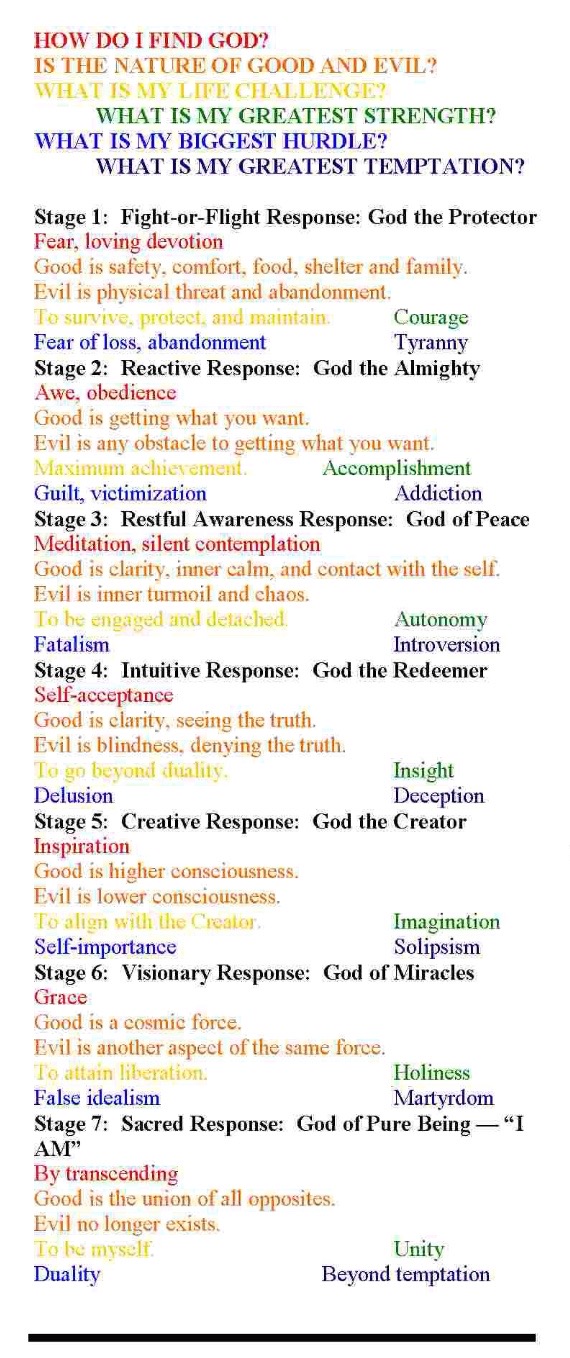
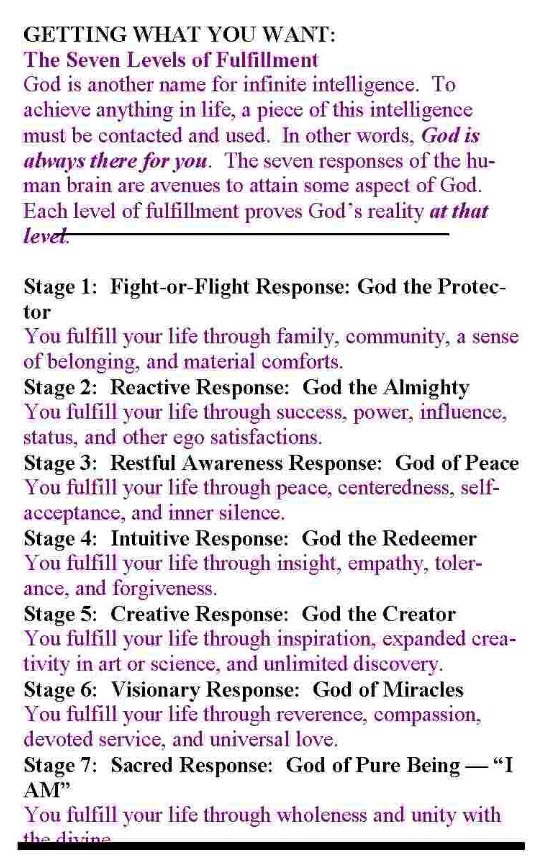
In stage six it is no longer necessary to seek God, just as we do not have to seek gravity. God is inescapable and constant. Sometimes he is felt with ecstasy, but just as often there can be pain, anguish, and confusion.
This mixture of feelings reminds us that two entities are coming into conjunction. One is spirit, the other is body. 147
If God is like a force field in stage six, grace is his magnetic pull. Grace adapts itself to each person. We make our choices, some of which are good for us, some bad, and then grace shapes the results. 148
Karma means always wanting more of what won’t get you anywhere in the first place. 166
Your enemy is not evil but lack of attention. The various practices known as prayer, meditation, contemplation, and yoga have been highly valued over the centuries because they sharpen attention and make it easier not to miss the clues to spiritual reality. A spiritual person is a good listener for silent voices, a sharp observer of invisible objects. These traits are more important than trying to act in a way that God would reward with a gold star. 196
What’s the one thing you can do today to grow in spirit? Stop defining yourself. Don’t accept any thought that begins “I am this or that.” You are beyond definition, and therefore any attempt to say “I am X” is wrong. You are in passage. You are in a process of redefining yourself every day. Aid that process, and you cannot help but leap forward on the path. I/ Our love is bound up with hatred, our trust with suspicion, our altruism with selfishness. Because this is so, the only clear path to God is a path of constant self-awareness. You must see through your own mask if you want to take it off. // A belief lies close to the soul. It is like a microchip that keeps sending out the same signal over and over, making the same interpretation of reality until you are ready to pull out the old chip and install a new one. 199
Because the whole notion that you are a fixed entity is a great illusion, and the sooner you see how varied and complex you are, the sooner you will drop the masks of your ego. 202
In order for a packet of energy to appear, to be seen by the eyes as photons, it doesn’t suddenly jump into material existence. Between the void and visible light, between darkness and things you can see and touch, there is the quantum layer. This level is accessible to our brains, which are quantum machines that create thought by manipulating energy into intricate patterns. 205
I used my brain to make this journey, or at least to begin it. But it wasn’t my brain that recalled his telephone number, any more than my radio contains the music I hear in my car. // It is my belief that the brain is the last stop downriver, the end point of impulses that begin on the virtual level, flow through the quantum level, and wind up as flashes of electricity along the trunks and branches of our neurons.
When you remember anything, you move from world to world, maintaining the illusion that you are still here among familiar sights and sounds. 214
Our minds are a vital tool in the search for God. We trust the mind and listen to it; we follow its impulses; we rely on its accuracy. Far more than this, however, the mind interprets the world for us, gives it meaning. To a depressed person the sight of a glowing Tahitian sunset mirrors his sadness, while to someone else the same signals to the retina may invoke wonder and joy. As Penfield would say, the brain is recording the sunset, but only the mind can experience it. As we search for God. we want our interpretations to rise even higher than our minds can take us, so that we might understand birth and death, good and evil, heaven and hell. When this understanding extends to spirit, two invisible fields, mind and soul, need to be connected if we are to have any confidence in them. 218
The problem is always fear of the intense emotions that occur at the mystical level. Experiences so real and profound that we cannot easily comprehend or accept them… Another way to describe our blocks is to say that we don’t want to change our priorities, nor our beliefs about ourselves and God.” [Dr. Valerie Hunt, Infinite Mind, 1989] The mind field, it seems, is a mine field. 219
A person with plantar fascitis, had become increasingly in pain from continued stoicism and only sporadic attempts to do some suggested exercises. In desperation, he limped in to see a Chinese healer. The very unremarkable looking healer felt his foot and then made a few signs in the air behind his spine — without touching him. When he stood up, his pain was completely gone! The healer said that the body was an image projected by the mind, and in a state of health the mind keeps this image intact and balanced. However, injury and pain can cause us to withdraw our attention from the affected spot. In that case the body image starts to deteriorate; its energy patterns become impaired, unhealthy. So the healer restores and corrects the pattern — this is done instantly, on the spot — after which the patient’s own mind takes responsibility for maintaining it that way.. After the person continued to walk around in amazement, the healer told him casually that he could be trained to do the same sort of work. The person asked what would it take to accomplish something like this? The healer answered, “You only have to discard the belief that it is impossible.” 222 [summarized]
Now I realize that it isn’t the miracle that creates the believer. Instead, we are all believers. We believe that the illusion of the material world is completely real. That belief is our only prison. It prevents us from making the journey into the unknown. To date, after many centuries of saints, sages and seers, only a few individuals can open to radical change in their belief system, while most cannot. Even so, our beliefs must eventually shift to conform to reality, since in the quantum world, belief creates reality.
As we will see, our true home is the light, and our true role is to create endlessly from the infinite storehouse of possibilities located at the virtual level. 223
Material level. Quantum level. Virtual level (spirit)


Circling the Sacred Mountain: A Spiritual Adventure Through the Himalayas by Robert Thurman and Tad Wise
Excerpts from Circling the Sacred Mountain
An interesting meditation: (p 59)
Settle into a meditation state. Calm yourself by focusing on your breath. Just breathe – count ten inhalations. Once you’re calm, begin to visualize. Imagine a field of vision up above your forehead, which you see with your mind’s eye, your third eye, rather than with your normal eyes — a kind of space and light, a boundless sky. In that sky is your greatest mentor. It could be some great teacher you had in school, a parent, or a grandparent, Jesus Christ, the Buddha. Whoever the person is, whatever the religion, it doesn’t matter; the race, gender, and era don’t matter. Choose him or her to embody the state of being that you aspire to — enlightenment, the total knowledge of everything worth knowing.
Visualize that person present there before and above you as a body made of light. Now the being looks at you, and you see the face — it’s hard to visualize whoever it is, at first. It’s just a flash, because your mind is unsteady. You see that being up there above you — I’ll just use Jesus Christ because that works for me — right here, not dead two thousand years ago, and he’s happy that you’re going to meditate now. He’s looking down at you, smiling because you are concentrating on opening your mind, and from his smile light rays flow down. Like streams of medicine, they flow into you and make you feel more light. You begin to feel blissful and buoyant, as though a spotlight is shining on you, lifting you up in this spiritual limelight that makes you glow with bliss. It drives away smoky, dark doubts, negative attitudes, and worry. Visualize that you’re being bathed in this radiant aura emanating from a being of total omniscience. It takes a lot of imagining. Don’t forget to breathe — you must breathe to imagine. At least in the beginning.
It is crucial to develop this positive setting before meditating on anything. A luminous setting is the key to lifting ourselves out of our habitual ruminative thoughts, our sense of self-identity, our self-world. We need to enter into the space of saints and sages and gods and goddesses and create anew space of possibility for ourselves. We don’t just say: “Well, I’m going to do something, but it’s going to be the same me that does it.” This goes along with the presupposition that after I finish it’ll still be the same “me” who just spent time meditating. Instead we start meditation by creating an ideal space, and then we enter that space and everything opens and becomes possible. This is a path of becoming aware of and then shifting our sense of orientation, substituting a more positive view.
This space where we take refuge when we meditate is known as the refuge field. It is a kind of portable shrine we learn to live with, as we make our lives more and more spiritually positive.
Now fill the field around you on your level with a great crowd of beings below the luminous presence. These beings cannot see the enlightened beings above, since they are not consciously seeking refuge, but they can see us. In the front ranks of this crowd are all those we know closely — our lovers, our mates, our children — looking to us because they sense that we’ve entered a different field. They perceive the light that suffuses us from the mentor-being as our own new glow. For this reason they’re smiling too. Their pleasure manifests in more light and energy flowing back to us in turn as more empowerment, more energy and encouragement.
From the mentor-being to us, to the other beings, back to us, and back to the mentor, a figure-eight circuit flows. We sit at the central point of the figure-eight. We’re not just developing in isolation, we’re beginning a conscious evolution in relationship with all those around us.
When you get a little more stable in this meditation, you try to include people you don’t care about, and then even people you dislike. But don’t try that right away or it’ll put you in a bad mood. Instead work on creating this figure eight of light and love. Cultivate this field of bliss, which you have earned through much evolutionary struggle. Sense the incredible preciousness of this accomplishment. Feel pleased with yourself, soberly impressed with what you have achieved. You don’t need to adopt a completely different belief system as long as your old one allows you to feel that you are precious. So hold that thought. Proud, pleased, and happy, glowing with energy.
Without leaving the refuge field, we turn to our next theme, impermanence. Right away we address death, reflecting upon how transitory life is. We know very well that some of our plans may not come to pass. We have no idea at what time we actually wil die. Sure, we’re going to die. All beings die. Therefore, we meditate upon what are called the three roots of immediacy.
The first root is the certainty of death. Death is instantaneous when it happens. It’s the withdrawal of your awareness from your senses and your body, your consciousness shoots out into a dreamlike state. Developing a strong certainty that we are going to die liberates us from unfocused practice.. It dawns on us that this body and mind and these five senses will cease to be.
The second root is the uncertainty about when we will die. Often children die before their parents, well people die before sick ones, a person in safety dies before one in danger. There is no certainty. The causes of life are few and they are fragile, the causes of death are many. We habitually go along secure with the idea that there’s going to be some time later when we’re going to die, “when you are old and full of sleep,” but there is no knowing when.
The third root is the certainty that when we do die the core of our being is what we will take with us: The Dharma is the only thing that will help us. Our bank account will not help us at that time; our muscles, our nerves, our skin will not help us at that time; our organs, liver, heart, none of that will help us at that time; our eyes, ears will not help us at that time; our friends and relatives will not help us at that time; our course beliefs, our factual knowledge will not help us at that time. The one thing that will help us at that time will be how much of the Dharma we have integrated into the core of our being: our openness, fearlessness, tolerance, generosity, intelligence, calm. That’s what helps us confront death. It’s all we can take with us.
If we neglect the deep core of our being, it shrivels. If we are intolerant, clutching, not generous, with no concentration, then we’re going to be in trouble when we die. The only thing that will help us is what we have invested within. While meditating on this third root, take an inventory of your life. Realize that you’re spending 95% of your time strengthening your body and making it healthy, spending money on medicine, earning money to pay for clothing, medicine, food, face lifts, cosmetics, vitamins. You pamper your body of this life although after death it will turn into garbage. You make huge investments in possessions and property, none of which will belong to you in the future. Someone else will be signing the checks. The government will be taking its inheritance tax. The kids will be blowing it on this and that. And yet we spend 95% of our time on these things we can’t take with us. What a waste!
From the three roots grows our awareness of impermanence, of the immediacy of death. We come to feel that there is no time at all. We become alert to the moment, making the moment as full as possible, because we’re not investing it in some other thing. We don’t know what could be happening next, so we concentrate on what is happening now. This kind of awareness. held in creative tension with the preciousness of human life, is extremely liberating.
Concluding, look up again into the spiritual sky above you. Your mentor or mentors, he or she or they, are delighted that you’re reflecting on these deep themes. Their pleasure at your understanding flows toward you as a cascade of nectar. The mentors themselves actually dissolve into light, flow down, and come to rest in the center of your heart. Their own life stream merges with yours.
Before we break the meditation we cherish a last taste of this nectar. Their luminous energy has filled our hearts; we arerenewed and refreshed. We must also remember gratefully to dedicate the merit of this practice for the sake of all beings — all those we have gathered around us and all the others behind them. Whenever you do something good, you should never leave it just by appropriating it to yourself. That would lessen the positive impact. You should right away invest the positive achievement — the merit — in the larger good of the world. This multiplies the good immeasurably. So in order to dedicate whatever merit we have created here today, we resolve to become perfectly enlightened buddhas so that we truly can become a mentor for all beings, to help them reach their own full potential, their ultimate freedom and happiness.
The trick is to get that infinite bliss and be totally present here in all this concreteness! That’s the real trick, that’s buddhahood. 64
The mind of immediacy is not a morbid mind. It is a liberated mind. All that’s inconsequential drops away, you see? But you have to really reflect on your own death, that that’ll be it for this life of hopes an dreams. You get all tortured about the great novel you’re going to write and all this. Then you’re going to be done. The novel is going to be dust! The libraries are going to burn down. It doesn’t mean you might not still write the novel, but you relate to it in a very different way. You become more immediate about the process of writing.68
We come now to the Buddha’s first noble truth, the noble truth of suffering. People first hear of this theme and think it’s the morbid invention of a killjoy. But it’s not gloomy; it’s merely realistic, a method of evaluating “what is our actual experience?” First we notice how difficult it is to even steady the mind to make such an inquiry, for our internal monologue is constantly demanding, “How can I feel better?” Constantly thinking:”When Iget there, then I’ll feel good.” “When I wake up tomorrow I’ll feel good.” “When I have this food, that thing, that relationship — then everything will be all right. “72
We’re habitually out of balance, and all of our experience will inevitably be frustrating and unsatisfactory. We have to acknowledge this and accept the fact that we’re off balance. We’re simply not going to find happiness, the way we’re facing our situation, feeling ourselves alone and struggling in an alien world, trying to get the better of it. Once we’re set apart in this way, in the battle of self versus the world, the self has got to lose. The world is bigger and stronger; it’s inexhaustible, while we get tired so easily…
When you meditate on this carefully and thoughtfully, you begin to feel genuine sympathy for yourself, you begin to excuse yourself from chasing your illusions. 75
Turning to the second noble truth, the noble truth of causation, you begin to analyze the self-versus-the-world structure itself, since it’s clearly the cause of all the suffering….
Ignorance, which is the fundamental self-construction, or better, missknowledge, the habitual assumption of being a
separate, independent self, this is the root cause of all suffering, according to the insight of the Buddha…This is the first primal reaction of the alienated self — desire, greed, and attachment. When the world won’t give itself over to you, when it even comes to take things away from you, then you feel fear, anger, and hostility — the second primal reaction of the alienated self.76
Knowing that the causal pattern of evolution is inexorable on the relative level helps you avoid both the irresponsibility of reckless activity and the hopelessness that arises, from the fear of losing the positive results of good activity. 76
Once we feel compassion for ourselves we can allow ourselves to abandon compulsive pursuits. The immense relief we get from that abandon enables us for the first time to look at others and begin to feel real compassion for them. To develop this compassion, it is first necessary to realize that we don’t now feel real compassion for others. This can be a bitter pill, but when we examine ourselves we soon encounter a being so caught up in thinking about itself, in wanting happiness and not wanting any suffering, that not much attention is paid to others. We don’t really care deeply about others, except in rare instances when we are in love or in some other exceptional state. Being habitually preoccupied with ourselves, we don’t easily put another’s life-pulse ahead of our own. 92
Realizing this, we soon discern that the source of the like and the dislike is not something intrinsically objective in the person. It’s actually in my reaction to their pleasing or displeasing me. 93
Once we have impartiality as a foundation, we can begin with the first of the Sevenfold Causal Precepts, 1st Precept is known as mother recognition. This meditation is premised on the infinite past lives of ourselves and others… //seeing all beings as our mother. // People start to look familiar, no longer strange. 95
2nd precept is Gratitude. When we meditate on this we should reach the point where we feel so moved by the love of our mother that we become tearful.
3rd precept is Repaying that kindness. 2nd phase of Gratitude.
4th precept is Love. For all our mother beings. see the beauty in them. We can see where they could be happy and perfect. We don’t get caught up in their theater of pain and misery. We love them by seeing their loveliness.
5th precept is Compassion. We look clinically at our mother beings and we realize that for the most part they are constantly batting their heads against various walls, doing the opposite of what would make them really happy. They’re addicted to various emotions, delusions, bad habits. Finally it becomes unbearable that they should suffer so, and we vow: “I will do what I can, I will devote my life to relieving them of that suffering.”
6th precept is Universal Responsibility. Since God has not freed these mother beings of their suffering yet, I must do it. This wild resolution to do the impossible is the actual spark that kindles the spirit of enlightenment, the spirit that makes a being a bodhisattva. In the modern worldview of one single lifetime, saving the universe is an insane goal. But in our meditation, our vow to liberate all beings from suffering is calm and rational. For from the Buddhist point of view, we have infinite lives infinitely entwined with other beings, so we must free every single one if we want to free ourselves. It becomes the natural thing to do.
7th precept is the fruition of the previous six. You give birth to a new messianic soul that is resolved to place the needs of others above the needs of self and to exchange preoccupation with your own happiness for a preoccupation with others’ happiness. 97
Buddha gave an understandable explanation that the reason we don’t so easily love our neighbors is that we are caught in a distorted perception about the centrality of ourselves as fixed, independent, isolated entities apart from all others. 110
Then you restore your boundaries and you feel different again. But you suddenly realize that the difference between you and other things is habitual. It’s arbitrary, it’s relative. There’s no absolute difference between you and other beings. 116
The chief enemy who has been forcing us into one suffering after another is this self-preoccupation habit, which we have had since we were animals. 127
You focus on yourself and constantly think: “What can I get? Where do I fit in? Are they doing what I want? Are they meeting my needs?” These attitudes are the sputterings of the demon self-concern, the bars on your prison walls. 129
We begin with facing all the negative things that happen to us, finding the way not to let them bind us into negative-reaction cycles but turning them to our advantage instead… The first step is to take responsibility for everything bad that happens to us and not to project responsibility out, in order to use all our energies to evolve ourselves internally rather than to vainly struggle with the environment.145
“Henceforth I’lI only use positive perception.” This refers to an internal revolution. It doesn’t mean you annihilate your critical faculty. Everything is void, so everything is relative. Relative reality is fluid and not fixed, being simultaneously ordinary and extraordinary. It is multifaceted and ambiguous, easily provoking cognitive dissonance.
The purpose of practicing positive perception as mind reform is to stop blaming everybody else in the world, to stop seeing faults as others’ problems, and to take all faults upon ourselves. This empowers us to do something about ourselves and to take responsibility for our future and for the world. ..// We must change our habitual way of justifying our own faults by blaming the world into a new discipline of seeing our faults as causing our problems. Then we can use the energy from this challenge to eliminate our faults within. 148
The Blade Wheel states that “obsessed with pleasure we drown in suffering.” 156
I can change the past, by purifying the present and polluting no more… // Sin is what interferes with the infinite. Sin is what intervenes and blocks the figure-eight circuit, breaking us up…// All outward enemies would be seen as manifestations of old business. Suddenly nothing outside me can harm me, because I refuse to acknowledge the old border of me. There is no secret weapon anyone or anything can pull on me. For the smoking gun always comes from my own holster. 158
When we suffer natural disasters, instead of bewailing our fate, we reflect that our own unethical conduct and vow-breaking exposes us to this type of thing. At first they seem to come from nowhere, we don’t deserve them, and we feel out of control; but we can regain leverage if we recognize our own failings in the past as underlying causes.
Buddhists think there are angelic beings powerful enough to avert storms or divert floods. What happens to us is never a random accident. We can embrace even a natural disaster as a circumstance and an opportunity to renew our energy and intensify our spiritual development, rather than simply complaining in vain. We learn to consider even thoughts as significant deeds, causing effects far beyond the subtle medium of electromagnetic energies in the brain, in order to develop the subtle mindfulness about negativities within us even at the most subtle level. Mind reform involves radical attitudinal change, requiring that we not waste our primary energy struggling with external reality, but focus it internally in ourselves where we can become the masters rather than remain constant victims. This does not mean we should do nothing about external circumstances, just that we should keep our priorities straight. 170
With a little effort of critical thinking, we can go beyond this and realize that this moment itself is infinite. Within this moment are all the qualities of all of our past and future lives. It is like Nietzsche’s eternal recurrence: Everything we do we should be willing to redo for eternity. Everything we do reverberates for eternity, so we should live in ultimate concern for the quality of our living…// We should live in the infinity of the moment and find the power of taking responsibility for infinite consequences. // “Henceforth I’lI control myself with real love of freedom.” That freedom, the true sense of the infinity of the moment, is right here now. 173-4
So we need to intensify detachment to overcome our enemy of self-addiction. // Far more harmful than Mara the Tempter, is the devil of self-addiction each of us carries within us, mistaken for our very self. 174
Let’s be kind, let’s be happy, and let’s accept others’ kindness on the crown of our head. 175
“Mindful’ means we must know the subtle details, the little ways that have allowed each tiny bad motivation to creep in, because each has a huge negative effect. // The notion that the ultimate or nirvana is some place into which you float away is based on your flawed sense that you are a separated thing who could withdraw into the inner room of your falsely absolutized self. This — the delusion that we are or can be separate from the world is the source of all negative things. Nirvana is this world as experienced by an altruistic being — a truly other-preoccupied, infinitely expanded being — and so enlightenment means super-mindfulness of minute facts and minute consequences, not an awareness that is just blown away and collapsed into nothingness. 176
When we feel ready to gain the energy necessary to achieve the infinitelv positive, we have to be open to a healthy fear of the danger of the infinitely negative (hell, evil). 176
Enlightenment is the ultimate tolerance of the cognitive dissonance that grips you when you confront absolute and relative at the same time. Enlightenment is being simultaneously totally present to the relative and totally liberated in the absolute. Buddha is totally out of here, in nirvana, where nothing bothers him. At the same time he’s totally present here, concerned for all beings. 189
the four(?) remedies: remorse (You must genuinely acknowledge the evil things you have done. Really face them.), repentance, resolve never again to be the slave of the self-preoccupation habit, and the wisdom of voidness (really there was no reason to have done them, they’re not ultimately there; that’s where you break the chain). Repentance alone, as it tends to reinforce your sense of the concrete reality of the sin, is not enough. Ultimately, you have to see through the sin. When you truly see its voidness, you can break free, and then you really will never do such things again. 190
The relative self is the living self. When we get rid of the delusory overlay — our sense of a rigid, absolute self — we are released! Then our relative self at last becomes a buddha-self. This is what selflessness is. It does not mean you throw away, suppress, or destroy your ego. Understanding it strengthens your ego and liberates you. Buddha is smiling not because he wants people to commit psychic hara-kiri, but because he sees that it’s possible for people to get rid of the erroneous sense of absolute self. You’re simply getting rid of a delusion, you’re not getting rid of yourself. 191
We are also working on taking that little triumph in the day when you get rid of your self-involvement and just release yourself into your play or work. You get free of self-constriction and enter the zone of power. 193
…formula is that evil is infinite, but goodness is infinite squared — infinite times infinite. Because the infinite evil beings draw energy from their self-addiction, each works for one person only. But the infinite good beings draw energy from love for others, each works for infinite others.104
Now we know that it is considered a great blessing in the West to leave this body in your sleep – not so in Tibet.
Tibetans like to die wide awake. They also meditate with their eyes open. 207
In their ceremonies, the Lakota people say, “Oyatsuke Mi-yasun,” all beings are my mothers. All beings are my fathers. All beings are my relatives. 208
We learn to pretend as children. When a parent had something we wanted, we could be so sweet. As adults we’re still hinting for presents, flattering and stroking people to get what we want from them. Inside, we’re always dissatisfied, always wanting more from those we’re with, never enjoying just being with them. The other side of greed is stinginess with what we have. I hide things, lock them up, and repeatedly check my hoard to see it it’s still there. 210
Nor will I only avoid the stupidity of commission, but that of omission, too. It’s what they call mindfulness, which is the realization that life is a ten-board chess match — and every move does matter.
My self-habit is my jailer, keeping me from really being new, fresh, live, and joyous. But the jailer is just as much a prisoner. 227
This is what differentiates buddhahood from theistic visions of the highest deity, a transcendent being who is outside the world and beyond it and yet somehow inexplicably reaches into it. That illogical possibility that there is a non-relative, absolute being is transcended in the Buddhist philosophy by the concept of nonduality, that a buddha is a being who is infinitely present everywhere in the universe and yet simultaneously totally liberated by being infinite.238
Here the freedom made possible by voidness loosens the chain of evolution and lets us out of the prison of fatalistic determinism. 241
So when we can relate to something that is simultaneously there and not there, that’s when we’ve mastered nonduality. 256
Tantra… It isn’t that there isn’t good and evil anymore, but you use the language of ordinary and extraordinary instead, and you say, “I’m going to transmute the vision of the ordinary into a vision of the extraordinary.” 287
Tantric vows. You see everything as a magical, poetic reality. 304
Om mani padme hum declares that everything is perfect in every atom in every instant, that compassion and wisdom are present everywhere, that love is present everywhere.
Bliss emerges from everything everywhere. There is nothing to fear. Even when it looks like hell in front of me. I can just embrace it and it will turn into a bed of roses. 317
If you develop an inner murmuring like water flowing, your mantra will bring grace and gracefulness to your last stand. A death where the mind easily leaves the failing body and rolls on with the mantra unimpaired. … // It is the heartbeat of the strong love force of the universe.
Once you realize voidness or selflessness, what you realize is that your world is what you imagine it to be, maintained by the shared imaginative patterns of all beings. Your mind is completely intertwined with other beings minds, so we must focus our minds all together to create a better reality. Though it is fluid and subtle, there’s still an objective reality, because there are so many subjectivities other than our own 334
Full satisfaction isn’t addictive, because it opens out into endlessness, leaving you free of craving. Things that hint at satisfaction and then frustrate you become addictive, because you have to keep going back, hoping for better luck next time. 336
Now the saint returns to the marketplace, so focused in her transcendent magic that it persists, unencumbered by the unmagical world because she knows that the ordinary nests perfectly within the extraordinary. 340
Coyote Medicine by Lewis Mehl-Madrona MD
Before a person can be healed, he or she must answer three questions: 1) Who are you? 2) Where did you come from? 3) Why are you here? (p 28)
I saw that we create our own world – as surely as Coyote and Silver Fox created theirs in the story. That there is, in the physical world, no objective reality. That if we refuse to believe in healing, healing does not exist. If we sing and dance only of molecules and drugs, then molecules determine our fate and drugs will be our only hope. What we believe in is what comes true,….What we sing and dance is what will be. (p 111)
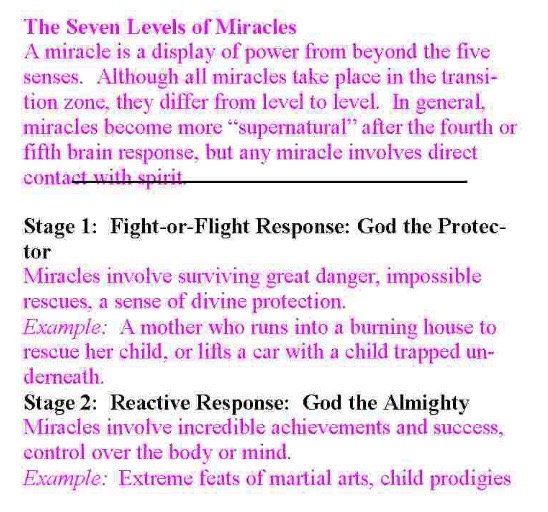
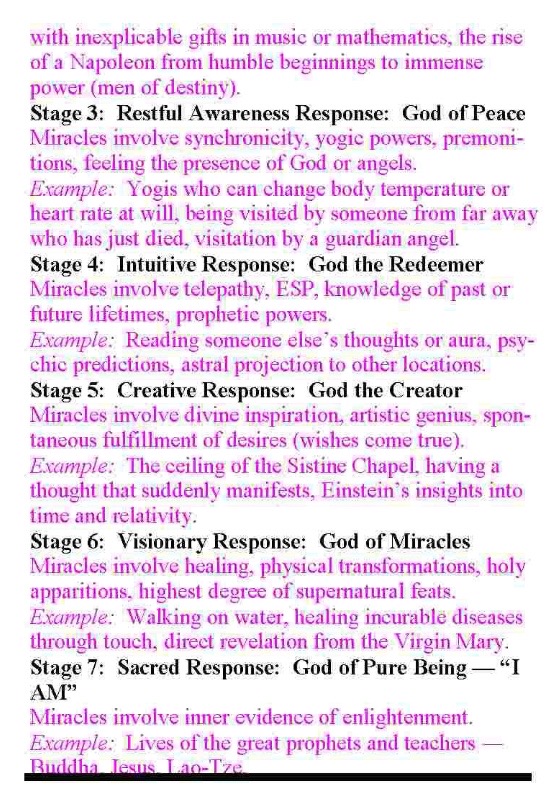
In the end, I think you have to accept serious accounts of the miraculous on their own terms, or reject them altogether. You can’t have it both ways. Scientific thinkers may feel that a rational exegesis of a miracle offers a back door into belief, but those who try to enter a spiritual life that way only find themselves in an empty room. (p 120)
I had to recognize that some of my patients and virtually all of my colleagues assumed that illness begins and ends in glands, tissues, and organs. I believed the less respectable view that illness also has its roots in the invisible world of the spirits, and in the stories people tell themselves. (p 120)
One Apache shaman I revered told me, I’m about as powerful as a dead chicken. The patient must do 70 percent of the work of getting well,” he said. “The Creator does 20 percent, and I do 10, which is barely worth mentioning.” Most of what a patient can do to get well, he told me, is to make the firm decision to be well.
This is where the medicine person steps in, by taking seriously a vision of the sick person as healthy, when no one else can or does. He or she creates with a patient a shared story of a mutual spiritual quest. (p122)
Shamans frequently change what they do, based upon divine intervention and guidance.
Through repetitive enactment, ceremonies can lose their power. Healers maintain a present connection with the spiritual realm, so they need not worry over whether or not a certain action is appropriate; they know. And healers respect the spirits of different illnesses by treating each one differently. (p 125)
Faith helps the healing to occur — but the principal truth is that active disbelief defeats healing, more than faith promotes it. (p 125)
A variety of tools — drugs and surgery among them — can be used to support a healing relationship, but the relationship is more critical than any tool. (p 145)
Each direction’s spirit has its own color and meaning. North means strength, and its color is red; South, compassion, is white; East, vision, is yellow; and West is black, because it means fear. If I let the fire take its own course, the experience of the lodge would be offset according to the fire’s imbalance; too much fire in the compassionate south would make for too mild a lodge: a western fire boded an almost unbearably hot, fearful lodge.//Four Directions Song actually includes 3 directions beyond those listed: Sky (up) which is blue and means protection; Earth (down), which is green and healing; and Center, the direction from which all relationship proceeds. No one color can symbolize it. // Science hides in the light of the library. When the doors close and light is extinguished, science is gone. Magic and nature enter through the cracks in the door, seeping into the rational volumes, flowing over the factual tomes that try to explain awav their existence. There are eyes in the night which are denied existence by the modern scientific world. These eyes watch, assess, guide, cajole, and encourage. The spirits behind them lead us through the darkness back to the dawn. // The silence between noises is night’s most profound offering. Between the rustling of the branches and the creak of tree limbs, between silence and sound, is the tension of flesh and spirit. Portals to other worlds lie within that tension, portals that science is terrified to imagine but that native peoples have known for centuries. (p172)
Remember. the greatest gift you have been given is freedom, and your greatest freedom is in choosing your own thoughts, words, and actions. (p 173)
Stories have preferences about where they should be told. I want to tell you one about how the medicine lodge came to the people — the same lodge I have taught you to lead. This is an important story which you will tell for years to come. The story must be told for the first time in a sacred setting, so I have brought you to this medicine spring. The animals here will also want to hear it. The stars will listen in, too. It is proper to tell the story here. (p 194) (195+);
Looking within a chronically ill person’s soul and finding the healing resources hidden there can be a little like stealing fire from the gods. Sometimes the coping mechanisms we have learned to deal with an illness end up keeping us sick. People develop habits that nurture and maintain illness. Since, when we are sick, these habits seem helpful, we become extremely reluctant to change them. Often these habits help us manage and contain otherwise unbearable emotion. But if a healer can steal, like Coyote, past a habit’s “defenses” (the monsters guarding the fire), he or she might find something that can be used to support the healing process. (p 213)
We were accepted and blessed, despite our mistakes and inexperience. Whatever is done with love and a prayerful heart is acceptable, imperfect or not, for love is perfect. Without love and worship, a perfect lodge, following all of the traditional ways, would fall flat. Love is the key. (p 218) see also P 233-236
Most people I have known who have been through a miraculous healing experience don’t like to talk about it much. There seems to be a sense that talk diminishes the power of the cure. I was once asked to produce a list of people who had experienced miracle cures, who would consent to be interviewed and photographed by Life magazine. None of my patients who had been through fairly spectacular cures would consent. And wisely so, I thought. Only those cured of moderately severe illnesses (rheumatoid arthritis, lupus, depression and the like) were willing to go public. Life scrapped the article idea. Moderate miracles don’t make good copy, though they are no less important to the lives they touch. (p 240)
My own experience indicates that with serious illness, after whatever treatment, 20 percent of patients will thrive over the long term, trusting steadfastly in their cure and in themselves. I have also observed that fully 75 percent of patients improve at the beginning of a treatment; most then gradually deteriorate. After a year, only the stalwart 20 percent remain. These stalwarts are fringe population. They are difficult to measure, because you will not find them filling out questionnaires in medical clinics. Their convictions have drawn them elsewhere….And the 80 percent who deteriorate and die as expected give the evidence majority practitioners need to persecute the fringe practitioners, to depict them as charlatans and quacks. How do the 20 percent thrive? The key, in my experience, is trust.
Trust is an implicit, deep faith that leaves no room for doubt or skepticism. “I believe this will work” is not trust’s end point; rather, trust’s starting point is “I know this will work.” Ritual helps human beings to trust. The powerful sensual appeal of ritual prayer, song, and dance allows us to forget our skeptical world view for a moment. We remember that we belong to the earth, as much as any rabbit or deer. Even our movements, our footsteps, honor the earth.
Through ritual, the earth honors us back. We are changed by a power that is not our own, an energy that transcends and understands us and engulfs us in its blessing. When we are in harmony with the earth, our cells are in harmony within us. Harmony is the music of healing. Disharmony produces cellular degeneration, viral infection, and dis-ease — AIDS, cancer, and so on. Never have we been so removed from the harmony of nature as today. Stress, sadness, or grief can be neutralized or absorbed by the earth, but only if we are in touch with her. If we have lost our connection to the earth, then we are not grounded, and we must endure, without protection, the lightning bolts flung our way. (p 241)
Ceremonial treatment methods are the most powerful I have encountered. Time and time again I have had the experience of working for weeks with a patient to change a situation, or improve a physical symptom, almost without results. Then we would do a ritual together, and an immutable problem would transform literally overnight. (p248)
Shamans did not set up schedules of meetings with patients. They did not ask them to come by the lodge once a week for an hour’s session.
Shamans worked with someone until either the person was well or there was nothing left to be done. (p 249)
See Story 252- about characters in the sweat lodge ceremony.
Clients come usually for seven days, and sometimes longer. A few clients came for a shorter time, either to sample the program or because their problems were less severe. For severe problems, a minimum of seven days seemed to be necessary. (description of his Healing Intensives) (p 255)
When we enter the past or the future, or journey into the spirit world, we meet spirits. We may find ourselves inside another’s skull or within the body of an animal, sharing its thoughts, movements, and feelings. But afterward we do not say, “I was a bear in a past life in the seventeenth century,” or “I fought Geronimo in Arizona.” This is far too linear for the Native American world view. Rather, we share an experience. “I was with a bear. My spirit mingled with its spirit and, for a time, shared its earthly robe.” Where is that place? “Over there.” One points vaguely into the distance, meaning the spirit world. Where is the spirit world? “Everywhere and nowhere.” [now here] (p 260)
Do we create forms for spirits to occupy which conform to our world views? It seems we must. Native Americans create shapes in accord with what they find surrounding them in nature. Hindus create fantastic shapes, such as the god with ten heads and eleven pairs of arms, or the god with a human body and an elephant head. Christian angels are most often represented as humans with wings. Christ walked in a human form. We create shapes we are comfortable with, and allow a doorway of consciousness to open so that the spirit can enter the shape. // The creation of spiritual well-being was always the goal of the medicine people with whom I studied. They believed that physical and emotional well-being would quickly follow. They were constantly engaged in the process of helping sick people envision a future, since you must envision one before you can have one. The ability to imagine a future leads to hope, which requires a certainty that what we seek is attainable. The medicine person turns the attention of the sick person toward the Creator, who is the source of hope; the focus is on reestablishing a person’s relationship with the Creator. (p262)
As anyone who has sat on a committee knows, cooperation takes time. Evil begins as the desire to shorten the process of creation by bypassing cooperation. If I want you to agree to my project, even though it isn’t good for you, I must find your weaknesses and manipulate them. This is what Iktomi does. Iktomi does not have the power to bypass your will entirely — only to trick you into going along with his own plans. (p 263)
Coyote as clown reminds us to laugh at ourselves and our problems. Laughter can come only when we gain perspective — a worry that isn’t funny to us in the moment may be in a few years, once we are out from under its shadow.
When I can get patients to laugh about a disease, or perhaps the foibles that are behind it, I’ve helped them on the way to the kind of perspective that can result in healing.
Coyote as trickster can be useful in generating a healing surprise, a shock that moves a patient from habitual state of illness into another more precarious one, from whence he or she can “fall” into wellness. It strikes me too how useful stories are to Coyote here — to trick pessimistic clients into unconsciously believing they can be healthy again, despite any convictions they may have to the contrary.
What about Coyote as survivor? The coyote that has extended its domain across the continent is an animal who is adaptable, who will try anything. If we truly want to be healed, we must be similarly willing to try anything that works. If we truly want to be healers, we must be willing to use anything that works, regardless of our theoretical positions. Because if it works, it’s good medicine. (p 286-7)
Quotes from STAGES OF THE SOUL: The Path of the Soulful Life by Father Paul Keenan
The word Utopia has Greek roots meaning “good place” and “no place.”
Jean-Paul Sartre described human beings as always trying to fil up a hole. Instead of being content with our freedom, he said, we are always trying to limit it by having something, doing something, being something. Sartre felt that human life was an absurd tug-of-war between trying to be free on the one hand and trying to be somebody on the other.
The truth is we can have deep and abiding peace in the midst of terrible conflict.
“To know what is and to adjust one’s life to that knowledge is the highest natural wisdom of man, a wisdom that inevitably points the way to the source of all truth.” Professor Robert J Kreyche
That experience propelled me across the threshold of discovering that my life was a tapestry, not a bunch of disconnected threads thrown into a basket.
The soul stage of tapestry reminds us that when life seems random and ugly, oftentimes we are looking at the bottom of the design. It is the work of the soul to help us see the eternal pattern, and to follow that pattern toward the realization of a beautiful handiwork.
If we are artists, we might think of eternal beauty and its three qualities so magnificently named by Thomas Acquinas — integrity (wholeness), consonance (every part contributing to the tone of the piece), and clarity (brilliance, luminosity, and accessibility to the soul) — and might make those three qualities the objects of our attention and our focus.
Quote from Nietzsche: “Anyone with a why to live for can put up with almost any how.”
In our society, it seems that this is the one thing we are afraid to do with couples, whether their marriages are fine or whether
they are in trouble. We’ll talk about trust and listening and forgiveness, all of which is fine. But we seldom talk to them about God. Seldom do we tell them that they have come together for a reason. Seldom do we tell them that, instead of being a stumbling block to growth and happiness, their spouse’s faults are a precise call to the areas in which they (not their spouse) need to grow. Seldom do we tell them that their spouse is part of their mission on earth, that missions are often difficult, and that we are tempted to abandon them just when the going gets tough.
I have seen new life spark in marriages when I have had people reflect on the John 14, where Jesus says, “I am going to prepare a place for you.” When I ask them, “Do you want to find your special place?” They often nod. “Then look into your spouse’s eyes,” I tell them.
Like the prodigal son, we know where home is, because we have been there once.
Your willingness is the key that unlocks the attic door (the upper room, that special place where we meet God and our Soul).
The word “re-enchantment” comes from the French word chanter. It literally means “to sing again.”. Once I realized that bit of etymology, it occurred to me that it is the perfect word to describe the problem of how to experience the enchantment found in the stage of attic wisdom once you have found yourself back on earth.
“Stations of re-enchantment” — places or pockets of time that enable us to reconnect with the eternal and to “stay tunes” to its beauty and joy. Stations — comes from a Latin word meaning “to stand.”. Its primary meaning is “places to stand on.”
Molecules of Emotion: The Science Behind mind-Body Medicine by Candace Pert
Peptides are tinypieces of protein consisting of strings of amino acids, joined together like beadsi n a necklace. When the chain is 100 + amino acids, its considered a polypeptide 200+ amino acids is called a protein. There are 20 known major amino acids.
Robert Plutchik, a psychology professor at Hofstra Univ proposed a theory of eight primary emotions — sadness. disgust, anger, anticipation, joy, acceptance, fear and surprise — which, much like primary colors, could be mixed to get other secondary emotions. E.g. fear + surprise = alarm, joy + fear = guilt. The experts also distinguish among emotion, mood and temperament, with emotion being the most transient and clearly identifiable in terms of what causes it; with mood lasting for hours or days and being less easily traced; and with temperament being genetically based, so that we’re generally stuck with it for a lifetime. (132)
Miles Herkenham concluded that the largest portion of information ricocheting around the brain is kept in order not by the synaptic connections of brain cells but by the specificity of the receptors — in other words, by the ability of the receptor to bind with only one kind of ligand. Miles has estimated that, counter to the collective wisdom of the neuropharmacologists and neuroscientists, less than 2 % of neuronal communication actually occurs at the synapse. (139)
The body is the unconscious mind! Repressed traumas caused by overwhelming emotion can be stored in a body part, thereafter affecting our ability to feel that part or even move it. (141)
The emotion-carrying peptide ligand facilitates memory in human beings. The emotion is the equivalent of the drug, both being ligands that bind to receptors in the body. What this translates into in everyday experience is that positive emotional experiences are much more likely to be recalled when we’re in an upbeat mood, while negative emotional experiences are recalled more easily when we’re already in a bad mood. Not only is memory affected by the mood we’re in, but so is actual performance. One extremely important purpose of emotions from an evolutionary perspective is to help us decide what to remember and what to forget. (144)
Our emotions (or the psychoactive drugs that take over their receptors) decide what is worth paying attention to. (146)
How can we objectively define what’s real and what’s not real? If what we perceive as real is filtered along a gradient of past emotions and learning then the answer is we cannot. (146)
Norman Cousins recovered from a broken elbow in record time simply by focusing for 20 minutes each day on increasing the blood flow through the injured joint, after his physician explained that poor blood supply to the elbow was why injuries to this joint healed slowly. (147)
Emotions are constantlv regulating what we experience as “reality.” (147)
Peptides serve to weave the body’s organs and systems into a single web that reacts to both internal and external environmental changes with complex subtly orchestrated responses. (148)
Peptides are aptly named Information substances
The question is: How can the mind mediate and modulate an experience of pain? What role does consciousness play in such matters? To answer. I must return to the idea of a network A network is different from a hierarchical structure that has a ruling “station” at the top and a descending series of positions that play increasingly subsidiary roles. In a network, theoretically, you can enter at any nodal point and quickly get to any other point: all locations are
equal as far as the potential to rule or direct the flow of information, // Conscious breathing the technique employed by both the yogi and the woman in labor, is extremely powerful.
There is a wealth of data showing that changes in the rate and depth of breathing produce changes in the quantity and kind of peptides that are released from the brain stem. (180)
Virtually any peptide found anywhere else can be found in the respiratory center. This peptide substrate may provide the scientific rationale for the powerful healing effects of consciously controlled breath patterns. (187)
We know that the immune system, like the central nervous system has memory and the capacity to learn. Thus, it could be said that intelligence is located not only in the brain but in cells that are distributed throughout the body, and that the traditional separation of mental processes, including emotions, from the body is no longer valid. (187)
Emotions. The neuropeptides and receptors, the biochemicals of emotion, are, as I have said, the messengers carrying information to link the major systems of the body into one unit that we can call the bodymind.. We can no longer think of the emotions as having less validity than physical, material substance, but instead must see them as cellular signals that are involved in the process of translating information into physical reality, literally transforming mind into matter. Emotions are at the nexus between matter and mind, going back and forth between the two and influencing both.(189)
Viruses use the same receptors as neuropeptides to enter into a cell, and depending on how much of the natural peptide for a particular receptor is around and available to bind, the virus that fits that receptor will have an easier or harder time getting into the cell…Could an elevated mood, one of happy expectation and hope for an exciting possibility or adventure, protect against certain viruses? One possible explanation for how this might work is that the rheovirus, shown to be the cause of the viral cold, uses the receptor for norepinephrine — an informational substance thought to flow in happy states of mind, according to the main psychopharmacological theories — to enter the cell. Presumably what happens is that when you’re happy, the rheovirus can’t enter the cell because the norepinephrine blocks all the potential virus receptors. (190)
All honest emotions are positive emotions. The key is to express it and then let it go, so that it doesn’t fester, or build, or escalate out of control. (193)
The same basic molecules of emotion are found in one-celled creatures which are found in trillion-celled humans. (194)
Think of disease-related stress in terms of an information over-load, a condition in which the mind-body network is so taxed by unprocessed sensory input in the form of suppressed trauma or undigested emotions that it has become bogged down and cannot flow freely, sometimes even working against itself, at cross-purposes. When stress prevents the molecules of emotion from flowing freely where needed, the largely autonomic processes that are regulated by peptide flow, such as breathing, blood flow, immunity, digestion, and elimination, collapse down to a few simple feedback loops and upset the normal healing response. Meditation, by allowing long-buried thoughts and feelings to surface, is a way of getting the peptides flowing again, returning the body, and the emotions, to health. (243)
Gregory Bateson defined information as “the difference that makes a difference.” That difference is “to the observer.” In the old metaphor, we ignored the observer in an attempt to avoid any taint of subjective interference in determining reality. In the new metaphor, the observer plays an important role in defining the reality, because it is the observer’s participation that makes the difference! (257)
Information is not dependent on time or space, as is matter and energy, but exists regardless of these limits! (257)
Bob Gottesman continues: “Consider that the body itself may be a metaphor, just a way of referring to an experience we all have in common. Maybe it’s that we don’t have consciousness, but consciousness has us.” (259)
Meditation is just another way of entering the body’s internal conversations, consciously intervening in its biochemical interactions. (263)
When we are playing, we are stretching our emotional expressive ranges, loosening up our biochemical flow of information, getting unstuck, and healing our feelings. (277)
Acknowledge and claim all our feelings, not just the so-called positive ones. Anger, grief, fear — these emotional experiences are not negative in themselves; in fact, they are vital for our survival.
It’s only when these feelings are denied, so that they cannot be easily and rapidly processed through the system and released, that the situation becomes toxic. And the more we deny them, the greater the ultimate toxicity, which often takes the form of an explosive release of pent-up emotions. (285)
Your mind, your feelings are in your body, and it’s there, in your somatic experience, that feeling is healed. (293)
Shifting the mind from shoulda, coulda, woulda types of thinking promotes self-regulation and healing on all levels. In the race of modern life, we all tend to adjust our sails far too frequently, running this way and that, always in a hurry, not pausing long enough to see the effect of our trimming on the course of our lives. Meditation provides an opportunity to stop and wait for some feedback before charging ahead on an uninformed course, a chance to let the body catch up with the powerful transforming effects of our natural information flow. (294)
We call this emotional resonance, and it is a scientific fact that we can feel what others feel. The oneness of all life is based on this simple reality: Our molecules of emotions are all vibrating together.
The Hidden Gospel by Neil Douglas-Klotz
“Every good tree bringeth forth good fruit, but a corrupt tree bringeth forth evil fruit” (Matthew 7:17)
When or if Jesus spoke those words, he spoke them in a Middle Eastern language, Aramaic. In Aramaic and in all the Semitic languages, the word for “good” primarily means ripe, and the word for “corrupt” or “evil” primarily means unripe. When heard with Aramaic ears, those words might sound more like this:
A” ripe tree brings forth ripe fruit, an unripe tree brings forth unripe fruit. “
This makes a world of difference. The tree is not morally bad, but rather unripe: this is not the right time and place for it to bear. The saying gives an example from nature. Rather than imposing an external standard of goodness, the lesson has to do with time and place, setting and circumstance, health and disease. (from intro)
Aramaic and Hebrew have only one preposition that must describe both the relationship “within” (as in “within my interior, emotional life”) and “among” (as in “among my exterior social community”). When “within” and “among” are the same word, then the way in which I treat the different voices within me — my interior “selves” — is always connected to the way I treat my friends, neighbors, and enemies — my exterior “selves.”
In addition, the Greek division of human life into “mind,” “body,” “emotions,” “psyche,” and “spirit” underlies the modern Western view. The Semitic languages do not divide reality in this way. They provide multiple words for the subconscious self, all tied to the communal self. They imply a continuum between what we call spirit and body, not a division.
In Aramaic, the name ALAHA refers to the divine and wherever you read the word “God” in a quote from Yeshua (Jesus), you can insert this word. It means variously: Sacred Unity, Oneness, the All, the Ultimate Power/Potential, the One with no opposite. It is related to the name of God in Hebrew, Elohim, which is based on the same root word: EL or AL. This root could be translated literally as the sacred “The,” since it is also used as the definite article in Hebrew, Aramaic and Arabic.
If we think deeply into this, we find it suggests that every definite “article” — every unique being — should remind us of the one Unity. If only one Being exists, then every other being must have a share in it. Individuality is only relative in this view of God. [page 27]
The Western idea of a”super-natural” event takes for granted that nature is neither conscious nor sacred . In the Middle Eastern view,however, events are always embedded in Sacred Unity, even when we don’t understand their purpose. [page 31]
 A-Maze in Grace