Category Archives: God Stuff
My Thoughts from Inside…On Praying, Peace, Miracles and Death…
Where is the Peace?
I suspect that inner peace is our natural state. Perhaps the state of a child, playing outside in the sunlight of a crisp morning in a world where everything is as it should be, is that state to which we are all longing to return.
As I fondly recall mornings (beginnings) such as those, I was certainly not dwelling on the past or worrying about the future. I was looking forward with alertness to what each next moment might bring or simply enjoying the wind rushing through my erstwhile hair follicles. It was a time of discovery, a time of adventure, a time of change, a time of promise from a pregnant-with-possibility-and-discovery existence.
How do we lose that inner peace and at the same time cling more tenaciously to the desperate hope that the next moment will be the same as the one we are in right now? Astoundingly this can occur even in the midst of bad times — so worried are we about change. Maybe as we are increasingly taught to judge the past by our elders, we fear the mistakes of the future. Perhaps this encourages us to view the present situations with the hope that they contain some permanence. For most of us, permanence is aligned with comfort. Many of those ingrained habits, although self-destructive, are nonetheless comfortable in their predictability. Our routines give us a place to relax and not have to chose. Choice is hard work. Conscious choosing takes effort.
It is my experience that my routine and habitual responses to stressful circumstances usually involve eating poorly. I suspect that whatever feelings of stress arise, my unconscious antidote is comfort food — which of course takes the form of sweets of the “there, there, have some of this and you’ll feel better, just treat yourself this once, your having a rough time” variety. Of course, I am so comforted by this while I sit and gorge and so un-comforted when I later reap the results.
Duh!
Another dynamic here is our Ego/Brain needing to be important and have a big role in our personal drama, so it makes for great theatre when we can have this incredible, on-going dialogue in our heads about What WAS. We can judge our past behaviors and then judge our judgments, feel bad about them, use our critical parent voices on them and generally get all worked up about the What WAS. Judgment and Guilt are the two main characters in this drama.
Then, based on our own What WAS or someone else’s What WAS (that we’ve read about or heard about) we can project those awful results into the future and have a great drama about What IF.
What IF has unlimited characters, subplots and really brings our pathetic Ego/Brain into the action. It is gleefully running hither and yon playing different roles, being the drama critic, and feeling soooo important and needed.
The main character, with varied costumes, is Fear.
In the mean time, our bodies, of course remaining in the Present are stuck with all the anxiety and tension generated by the dramas created by the Ego/Brain on the stages of What WAS and What IF.
To the extent we can keep What WAS and What IF safely in the background (the more distant the better) and allow WHAT IS to occupy the foreground, we can enjoy the peace of the Present — a true gift to ourselves and others
As Arthur Somers Roche once said, “Anxiety is a thin stream of fear trickling through the mind. If encouraged, it cuts a channel into which all other thoughts are drained.”
The Bible tells us that there are enough troubles today without borrowing from tomorrow and again like the birds of the air and lilies of the field, not to worry about tomorrow.
We can train our minds to chose what we think about. We are not stuck thinking only about what our Ego/Brain continually offers to us. We can direct our thoughts with our will. An interesting definition of emotion involves a continuum where at one extreme of highly emotional is the person who believes they have no choice whatsoever in what they choose to think. On the other extreme, the person realizes that they have complete choice in what they choose to dwell on. Neither of these statements ignores the fact that thoughts and feelings are usually simply tossed into our awareness. The issue here is what we do with them when they show up. Do we embrace the initial fear-filled thought and then stampede off on a herd of “ifs” or do we decide that we will shift our attention to other thoughts.
Quote from Gina Lake channeling Jesus: “Who is responsible for these thoughts and feelings? You’re not responsible for having an ego; it’s part of your software. AND you’re not responsible for the thoughts produced by this software, this programming. HOWEVER, you are responsible for any feelings you experience, because they are the result of giving your attention to the thoughts produced by the programming.”
It is said that one way to access What IS is through the body. Breathing, focused attention, and being in nature are three common techniques.
I suspect, yet have not reached a working awareness level, that I need to become more aware of my feelings related to the stressful events and then move toward acceptance. If I can notice and allow my feelings as they arrive, to be welcomed like guests and do the same with thoughts that just pop in, then I can dive into the core of the feelings or limitations, magnify, analyze and notice they are mostly empty space, with little substance. Then.. (using the Sedona Method) Be aware of the feeling. Allow the feeling.
Don’t label the feeling, just feel it.
Ask: Could I let it go?
Ask: Would I?
Ask: When?
And No is an OK answer to any of the above questions.
Another way to quiet the Ego/Brain’s incessant dramatic dialogue is to Play/Pray/Chant/Drum/Sing
An important component to this seems to be the idea we hold about the nature of this God to whom we pray. As we make contact, we can leave the world of What WAS and What IF and focus on our experience of God’s presence “right now.” This can bring about an immediate peace.
What WAS and What I get back on stage as we start thinking about our experience and judging the results. Is the God to whom we pray seen as…
# A Protector, where I am a Survivor and fit in by Coping, where I find God through fear and loving devotion; where Good is Safety, comfort, food, shelter and family and Evil is physical illness, threat and abandonment, where prayer becomes supplication for protection from an unfair and unreasonable world where my luck seems lost?
# The Almighty, where I am an Ego or personality and fit in by Winning, where I find God through awe and obedience; where Good is getting what I want and Evil is any obstacle to getting what I want, where prayer becomes bargaining and manipulating to work a deal?
# My Special God: where I am one of the Chosen Few and fit in by conforming to the law-and-order rules of this One True God and behaving myself, where Good is being part of the special saved and chosen group and Evil is being outside that group; where prayer becomes righteous expectation of reward for proper behavior and having read, quoted and invoked the special magic words required by the formula for salvation?
The other half of the coin of Praying Boldly and Ask-anything-in-my-name is that of Discernment or What-is-God’s-Will-in-this-matter.
One of the cruelest hoaxes perpetrated by the Church on the spiritual life of modern Christians is the notion that their prayers failed because they didn’t pray correctly or with enough faith. An alternative conclusion is the view of a world that is “not fair” and a God who “owes” us something after we’ve “paid our dues and been good.” Each of these views places us in a victim role — which is aided and abetted by our Ego/Brain who masquerades as our White Knight charging to our rescue — while never quite reaching where we hurt the most.
If we could discern/see the whole picture, we would understand that some events are more likely to happen than others. If we could truly see the WHOLE picture, the outcomes for which we pray would probably fade into insignificance. Given our partial sight and understanding, we can understand that we may have set in place a series of consequences that are now being reaped — and.. in the 11th hour they can sometimes be changed and sometimes not. Some of those consequences may have root causes deep in past lives, pre-natal or post-natal experiences. Perhaps experiences today can heal them and perhaps not until another time and place.
SUPPOSE (and I know these loom large from the normal Christian perspective)
- God UNCONDITIONALLY loves each and every one of us. Thus no one is in need of salvation from such a God’s condemning them to everlasting damnation.
- God’s Creation is still Good/Perfect as He created it — especially in the current unfolding Present Moment of
NOW and Eternity — as opposed to in the judgmental realm of What WAS and the fear-filled realm of What IF.
In other words, post-creation God hasn’t said, “Oh, no! That wasn’t supposed to happen! How am I going to fix this mess?” - God is the Unavoidable instead of the Unattainable and we are each completely and personally and intimately ONE with God.
- As individuals we are each following our own journey
WITH GOD WITH US EVERY INSTANT OF EVERY DAY. Our challenge is to notice this. Just because we go inside and close the door, doesn’t mean the sun stopped shining.
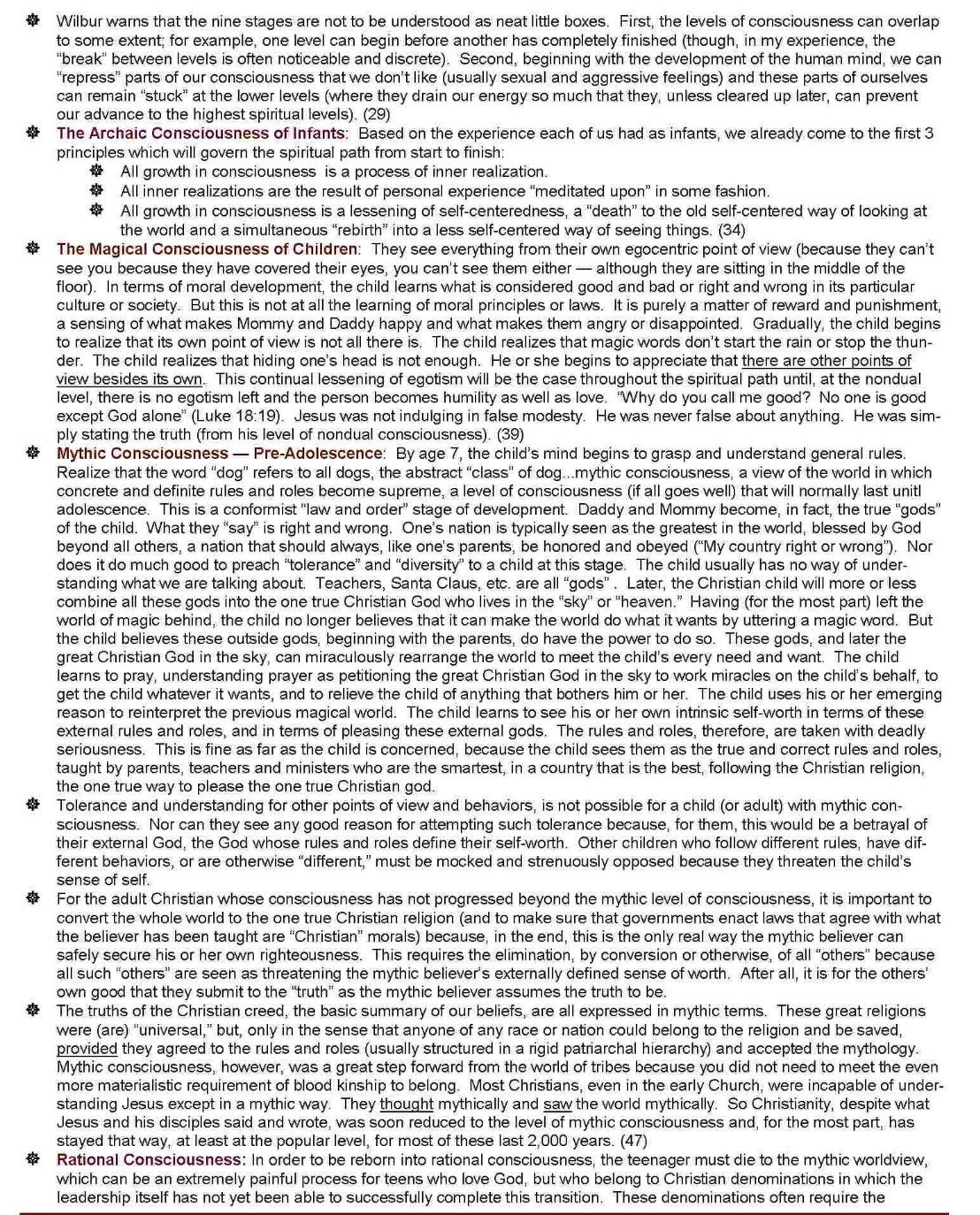
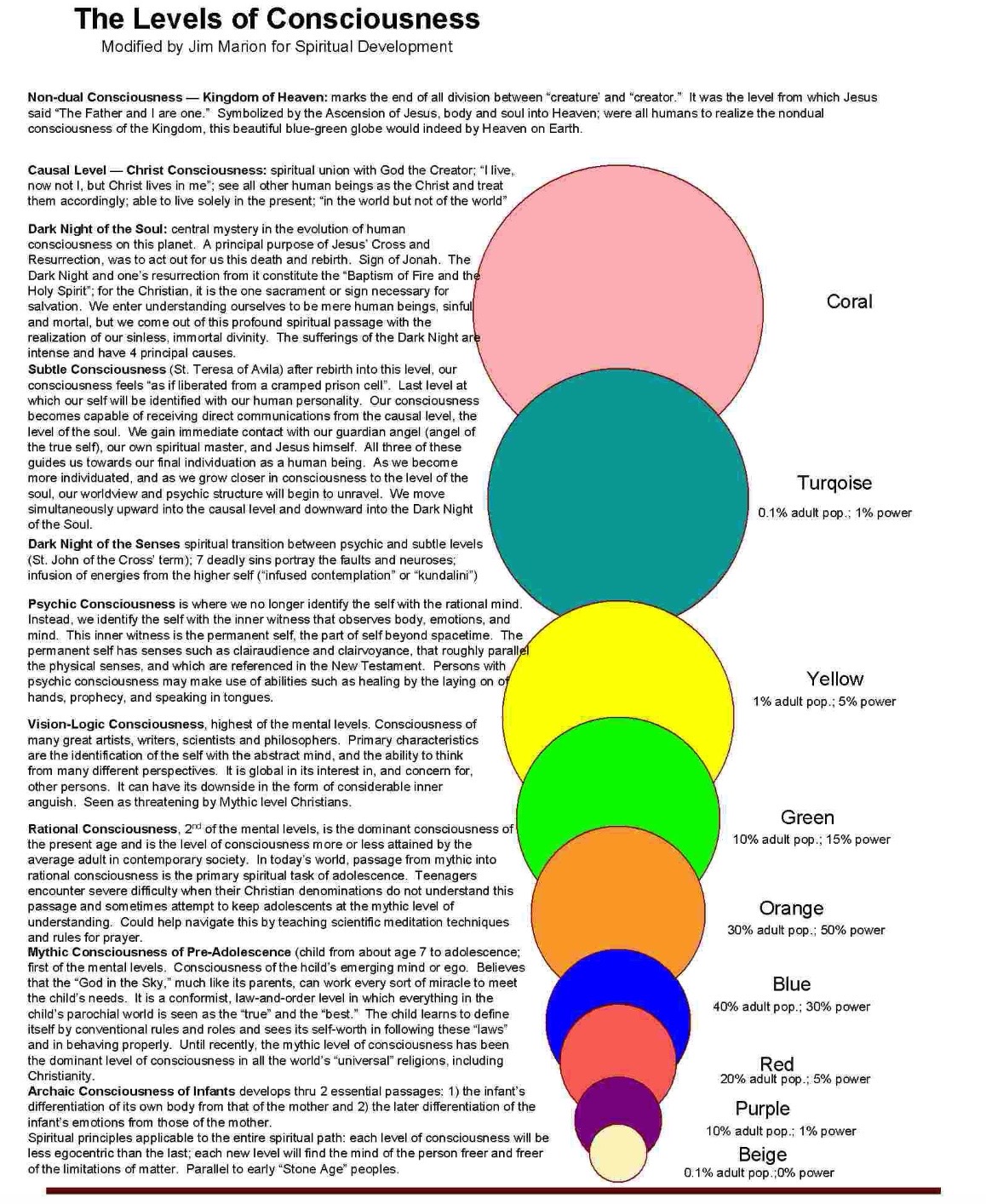
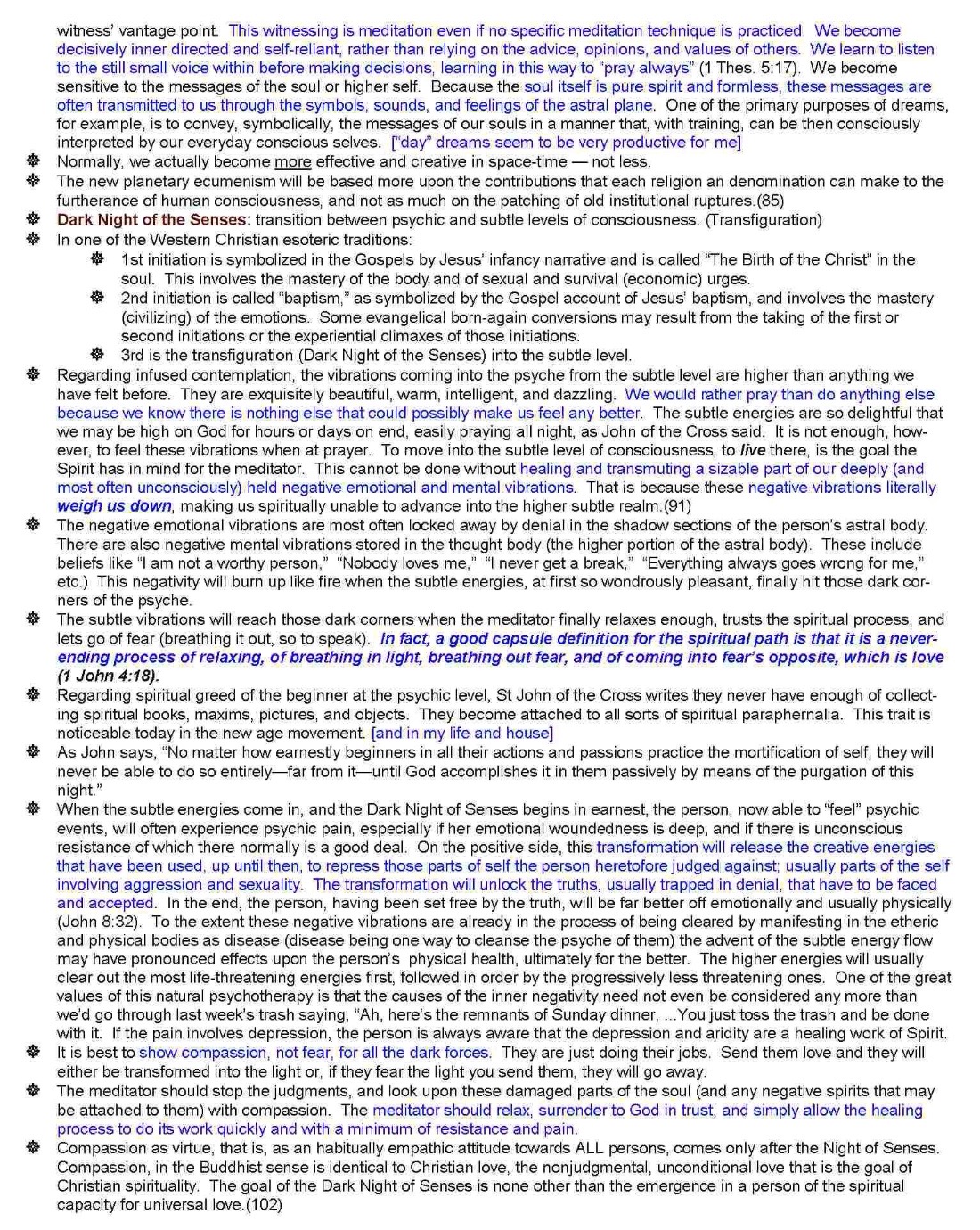
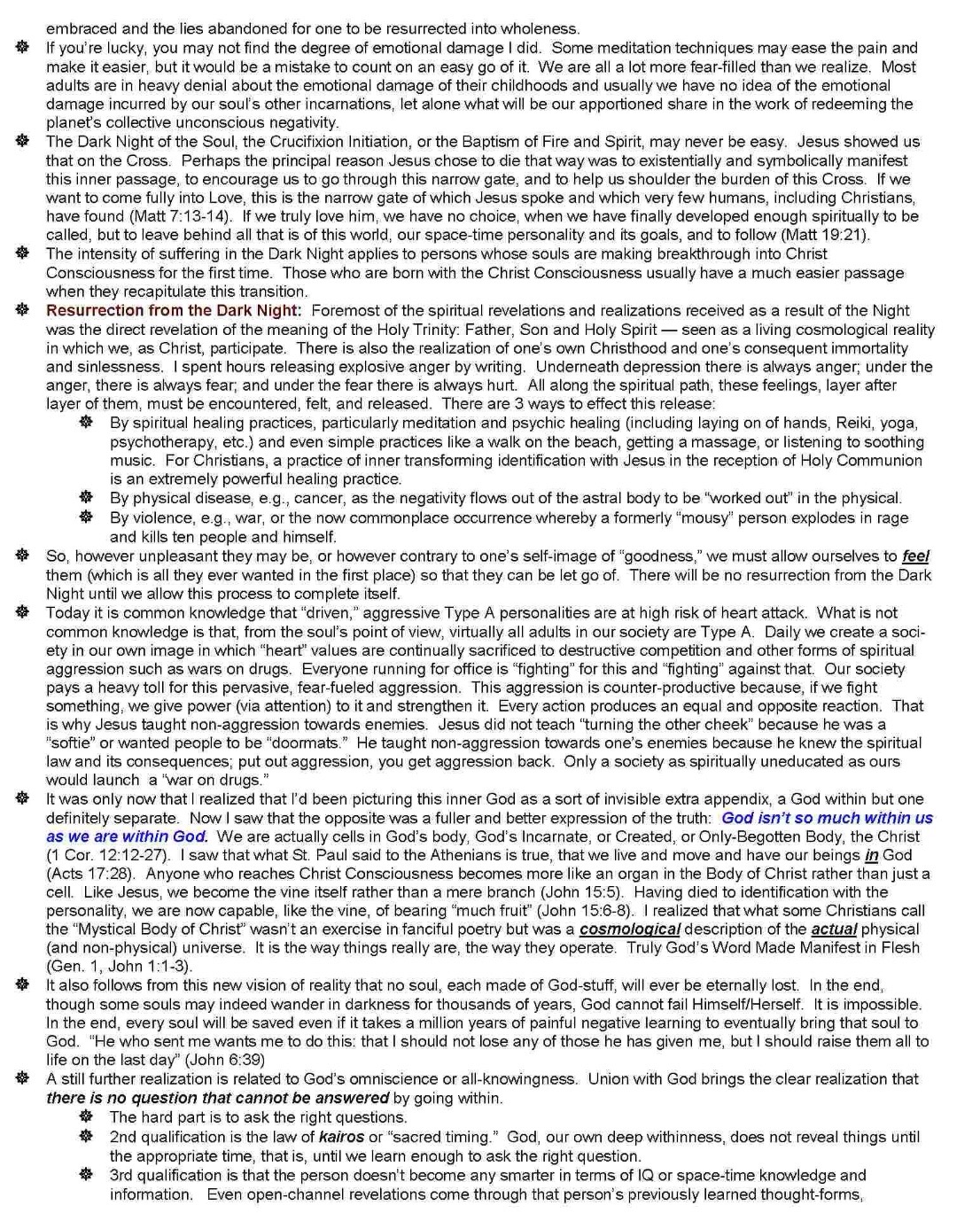
Our relationship with God is very personal. The level of Christ Consciousness is absolutely “the only way to come to the Father” because it is the 6th level in our human system of consciousness and we must go through it to get to the 7th level. It is simply our Energy Anatomy.
The fundamental essence of that Christ consciousness is way bevond the limited requirements of belief in the human body of Jesus and the various labels from doctrine and church dogma.
This level of consciousness has been accessed by mystics and others from all the religions and from people espousing none of them.
So, if we truly have an unconditionally loving God, intimately involved in our daily lives (standing at the door and knocking), how do we access this awareness for guidance and peace?
The Christ
For those of us with the upbringing and myth/story enrichment in our youth, we can have a constant companion and friend in Jesus the Christ. This can take many forms. We can talk to Him as we would a friend. We can imagine ourselves merging with him in Spirit as he enters our body to aid us with healing or other actions. We can cry in His arms, hold His Hand and have Him touch us for comfort and healing. We can hand over our burdens to Him. This works especially well with Judgment, Guilt and Fear. These just melt away in His Hands. We can turn parts of our body over to Him as we do when we listen to others with the Heart of Christ. We can use Him as our primary Guide on journeys into the Spirit World as well as any other adventures/explorations we might be about.
This is personal, private and intimate. This is Relationship.
This is in the Present. This accesses the part of us that is Made-in-God’s-Image, our Higher Self. It kindly and compassionately ignores our Ego/Brain’s ranting and raving dialogue.
The Buddhist View
One of the key tenants of Buddhism is Impermanence. In this context, that means we embrace change. We mistakenly see the world as a place of suffering rooted in our ignorance of the actual nature of the world, our mistaken belief that we are a separate entity and encouraged by our desires and attachment. When we are able to cut out the root of ignorance (like the head of a snake), all the coils of suffering drop away. To the extent, we can meet each new moment in our lives with the openness and vulnerability of a child, then we are open to the possibilities and infinite potential.
Like a hologram, each moment in time/space contains all moments in time/space. We are usually unable to access these possibilities because we have already decided that the last moment (day, week, month, year) will continue unchanged into the next one. If things are going well, that will continue.
If they just changed for the worst, that will continue to worsen.
A T-shirt says, “Just when I was getting used to yesterday, today showed up.”
We have a tendency to make What IS into What Will Be and then have that future become a self-prophesy vs Noticing What IS, and What IS Next. When we don’t desire and are not attached to a particular outcome, the possibilities are endlessly amazing.
This is personal, private and intimate. This is Relationship.
This is in the Present. This accesses the part of us that is Made-in-God’s-Image, our Higher Self. It kindly and compassionately ignores our Ego/Brain’s ranting and raving dialogue.
The Taoist View
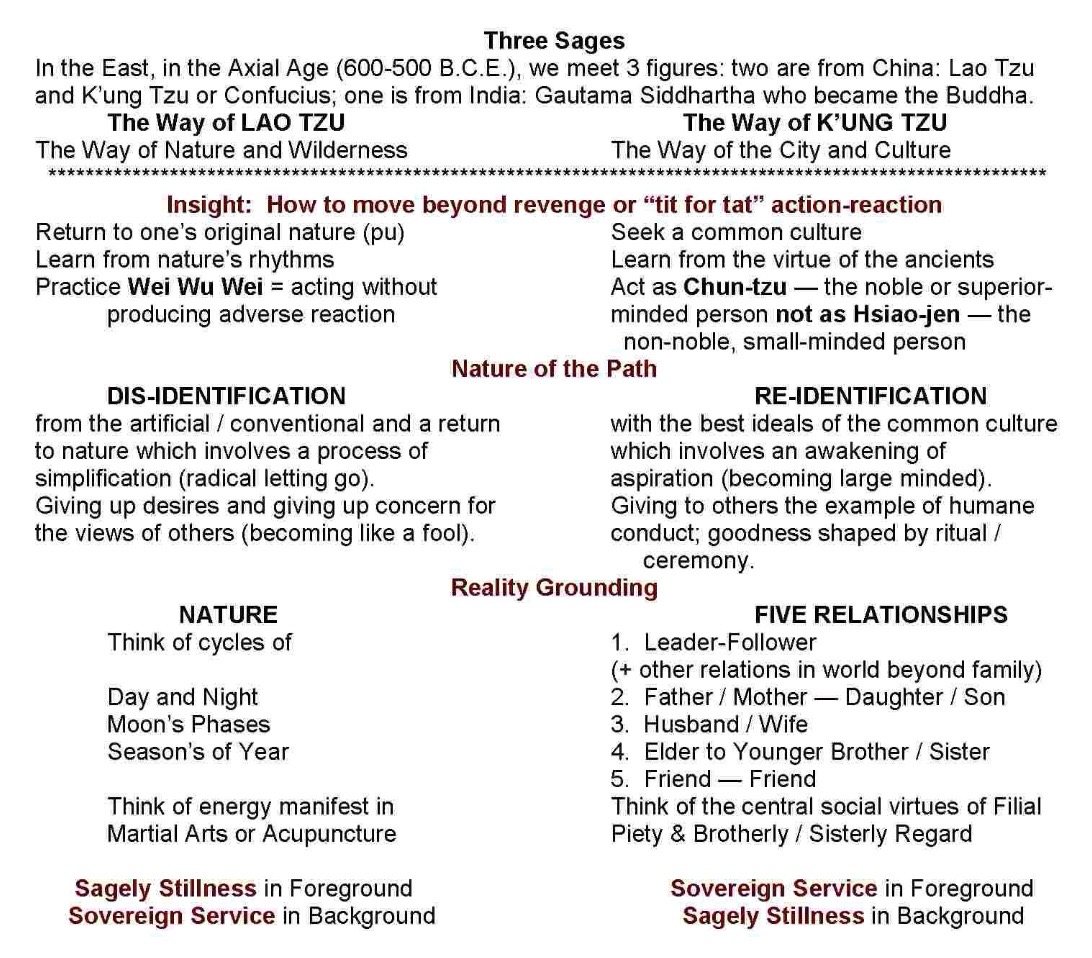
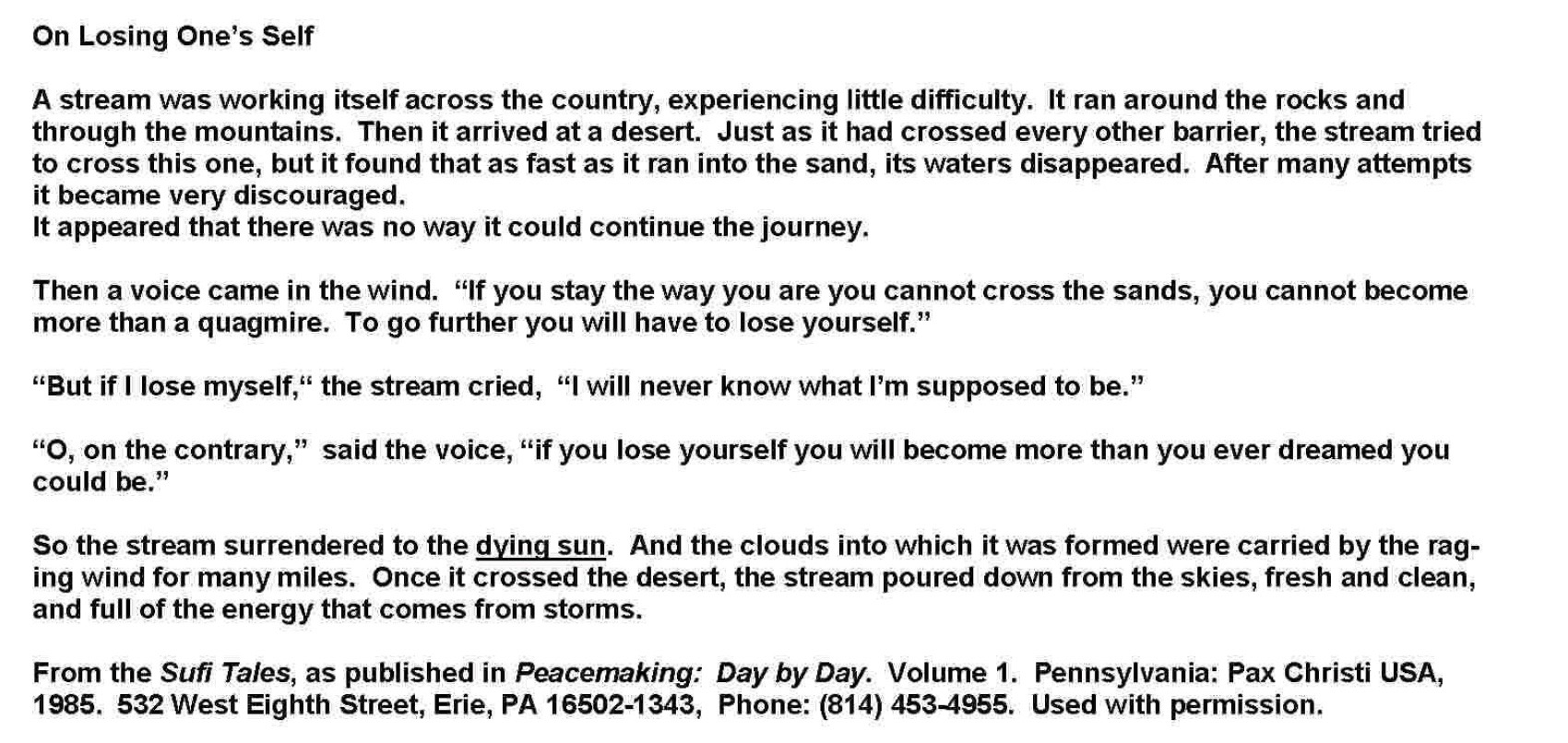
One of the key metaphors in Taoism is Water. It flows in low places, humbling itself. It yields and overcomes. When it meets an obstacle, it goes around, singing as it goes. The description of the Taoist sage describes someone fully aware of and present in the Now.
They look confused, because they are waiting, listening, discerning what is next for them. Following the Tao appears VERY nearly the same as following the Will of God.
This is personal, private and intimate. This is Relationship.
This is in the Present. This accesses the part of us that is Made-in-God’s-Image, our Higher Self.
It kindly and compassionately ignores our Ego/Brain’s ranting and raving dialogue.
Miracles and Healing
Jesus wandered the countryside healing people — often with the comment that “their faith had made them well.” Usually, there was an interaction with Jesus which was followed by the healing. We don’t have story after story of people sitting around all by themselves being healed because “their faith had made them well.” This has been twisted into a perversion where lack of faith leads to lack of healing.
If we continue in our Victim, powerless mentality then we will continue to depend upon miracles to “save us” from something (suffering, death, damnation or whatever). The medical profession and Western culture predominantly take the attitude that the Power is outside of the individual. It resides with the government, the experts, the drugs, God, the Bible, the right words approved by some group, luck, or whatever other shiny item we “need to acquire to succeed and be happy.” Connecticut Yankee in King Arthur’s Court aptly illustrates that one person’s miracle can be another person’s routine. It is all about how you see it. If I can “see” (with my understanding) that electricity can flow to a switch that can then be turned on, then the sudden appearance of light is not miraculous.
If I can see the flow of events as I watch from the Eternal Now, I am not surprised by change. It is arravyd before me like a tapestry hanging on the wall. If I fail to have preferences for the outcome, then I am open to more possible outcomes from which to chose. I can sooner and more easily “let go of that, and choose this.” I am more response-able to choose an outcome or Way to further explore — as opposed to being “frozen” in place, unable to let go of the past or my future version of “s’posed to be.” To the outside observer, miracles just continue to happen to me. The new events are unexpected and bring me joy.
I have often gotten waylaid investigating the “how” of things.
My science-bent early years encouraged me to look for the cause-and-effect chain. I figured if I could identify and label each step of the process, then I could better understand and describe the outcomes thus making my world more predictable, safe and comfortable. I would always “Be Prepared” like a good Boy Scout should.
After learning about quantum physics, I now understand that there is a certain amount of randomness built in to the apparent chaos despite an underlying, inherent orderly progression. I also have come to realize that labeling and story-telling about the cause-and-effect chain of events doesn’t bring us any closer to a real understanding of the world. A shaman’s explanation of phenomena evoking various spirits and paranormal sensory data is simply different from a 5 hour dissertation of multi-syllabic words describing the physiological, biochemical, and psychological processes that pretends to explain the same phenomena. ‘The simplicity of the shaman’s tale allows for far more intuition and imagination in its actual use and we can keep the actual result clearly in our mind.
Guilt is a potent by-product of our time spent in the judgmental realm of What WAS and the Fear-filled realm of What IF. On top of my current suffering. I can pile more suffering in the form of guilt feelings about the suffering I am supposedly “causing others” to experience. Of course I have to “pretend” I am the cause since I have no actual power to make another person “choose” to suffer in their own What WAS and What IF. If the other person is a loved one, then I can augment my own suffering with an even heavier guilt.
One of the Four Agreements is “Don’t Take it Personally – it is not about You.” This means that when someone else chooses to react in some manner to their own perceptions of the world and the circumstances in which they find themselves and then directs some body language, comment or diatribe in your direction, the reason and source of the outburst comes from them, not you.
Death as an Advisor
Carlos Castenada’s Yagui Indian guru, Don Juan describes Death as an Advisor who waits over your left shoulder.
The advice from Death is that of keeping perspective and not taking yourself too seriously. With this advice, we can more easily remind ourselves to cherish the Now — for that is the only time we have to live our lives.
Aside from some extra pain and suffering, if death is the worst that can happen, then that realization can lessen the horror of the world of What IF.
Exploring Stoic wisdom will find similar attitudes and advice.
Alan Hobson’s description of the Sherpas who work the high-altitude climbs brings all these things to mind. No matter what the circumstances, they remain equanimous, happy and work steadily on about whatever task they have before them.
Despite prodigious strength and physical prowess, they remain humble and self-effacing. An instance of this was one of the Sherpas, weighing about 125 pounds, routinely carried loads of 150 to 250 pounds. He did this with a band wrapped around the load which rested on his back and then simply extended looped around his forehead. They climb without crampons or ice axes. The band around their foreheads keeps their hands free. All this at 17,000 feet and up?!
My Thoughts from Inside…Praying without ceasing…
What are some of the signals that we are shifting out of communion with our Lord God and into some ritual-of-the-mind, habit, or addictive behavior? At times like these, we go “unconscious.” This is usually most obvious “after” the fact when we look back on our behavior and it was not what we would have chosen from our highest and best or from Who We Really Are.
What would we look like if we spent our time “hooked up” with Spirit? If Spirit moved us? If Spirit filled us and acted us?
We would look as described in the 15th Chapter of the Tao Te Ching…
—The ancient masters were subtle, mysterious, profound, responsive.
—The depth of their knowledge is unfathomable.
—Because it is unfathomable,
—All we can do is describe their appearance.
—Watchful, like men crossing a winter stream.
—Alert, like men aware of danger.
—Courteous, like visiting guests.
—Yielding. like ice about to melt.
—Simple, like uncarved blocks of wood.
—Hollow, like caves.
—Opague, like muddy pools.
—Who can wait quietly while the mud settles?
—Who can remain still until the moment of action?
—Observers of the Tao do not seek fulfillment.
—Not seeking fulfillment, they are not swayed by desire for change.
Probably the clearest model for reality is holographic. In a hologram, each piece contains the whole.
The larger the piece, the more clarity. This applies to time as well as space. This means that each moment and each place contains within it all the moments of the universe — past and future. In like manner for space. Since space/time is one fabric with different qualities, we could simply describe it as What Is.
Advice from Christ, Buddha, Lao Ise and other mystic spirit mentors is consistent around the idea that less is more. Knowledge is increased by adding things, wisdom is increased by losing or dropping things.
To be described as the “ancient masters” the Tao would be:
Subtle: open to the next moment’s change, not committed or blindly running down some previously discerned path towards a perceived destination that may have since shifted.
Mysterious: hard to predict from external viewpoints. Subject to unfathomable motivations or directions.
Profound: obviously containing a depth that goes beyond the norm. Solutions, answers coming from deep, powerful and wonderful places.
Responsive: Response able. Awareness of constantly shifting needs in the environment and in people around me and able to shift my internal orientation to accommodate and adjust to those needs. To love fully and appropriately.
Unfathomable: Probably reference to the “emptiness” or “void” that field of infinite potentiality into which we can go in the moment of NOW. Deep within. If we don’t go within, we go without.
Watchful: Where are the rocks? Where the ice? Where is the strongest part of the snowbridge, undercut least by the stream?Watching for cracks or settling of the snow. Listening for changes in the sound of moving water beneath. Mesmerized by the beauty of the crystalline whiteness. We wish to continue moving, following our own flow above that of the cold stream below. To drop in and get stuck is to expend unnecessary effort for survival — jeopardizing the journey. Watch. Wait. Move forward. Move backward. Move around. Pick your path carefully.
Alert: All senses up like radar. The opposite of frozen with fear, this is flowing with alertness. For some reason, Smiling during the crux, enhances the relaxation reflex. Allowing your awareness to expand. Relying on all of your senses. The Buddhists include the Mind as a Sixth Sense. Go from Small Mind (of worry and anxiety) into Large Mind (of expanded awareness of surroundings and feelings)
Courteous: Humbly appreciative of that which has been provided by our Host as we sojourn on this planet this day and this moment. We extend simple courtesies to those around us realizing that we have no genuine ownership or familiarity and are simply guests in this time and place.
Yielding: There is great power in water and great resistance in ice. Unlike most substances, water’s solid form is less dense (and thus floats and forms from the top down, not the bottom up). The tiny hydrogen bonds and hexagonal structure give ice great strength. Strength to split granite. Ice about to melt is strength unhurriedly and gently giving way to action.
Simple: As it is. Can we look at the world and see it “as it is” without dressing it in dazzling raiment woven from the threads of past judgments and future concerns? We weave and spin these two threads into of fabrics of intrigue, meaning, and fear? Less is more. Simple is beautiful. The uncarved block has a purity, vibrancy and life unencumbered by Ego’s accoutrements. No hidden agendas.
Hollow: Empty. Open. Available. Able to be filled and fulfilled. A place for shelter from the storms of life.. A place to echo our feelings and thoughts. A place of safety from which to venture and return to rest. Profit comes from what is there, usefulness comes from what is not there.
Opague: Clarity is not a constant. When following the Tao, change and flow are the constant. From the outside perspective, things often need to settle before being able to see.
Heisenberg Principle. Once clarity is attained, the elusive Now of Change has of course moved on and we are simply left with the artifact — to discuss, catalog and embalm for our tomes.
Who can wait quietly while the mud settles?
Things are often not clear. Especially under the pressure of deadlines and anticipation. We have become a world that highly values productivity. I suspect because it has been tightly tied to self-esteem which is related to earning money for stuff and status. If we are to be more and more productive, then we need to work smarter, better and faster. We are so efficient that we often lose our effectiveness and do something 3 times in a hurry faster than we once did it the first time properly.
Who can remain still until the moment of action? Who can wait upon the Lord? Who can pray without ceasing? Who can then be moved by that praver and not merely jump-started by the ego and circumstances?
Observers of the Tao do not seek fulfillment. Fulfillment from what? Others’ opinions? For how long? What have you done for me lately? Oh, we long for something permanent. If we work hard to produce it from our splendid productivity, then its value is related to how long it lasts before change makes it irrelevant or even obsolete.
Not seeking fulfillment, they are not swayed by desire for change. Not seeking permanence, they can go with the flow, enjoy the ride and the creations, without attaching to their permanent existence. So not being swayed by desire for change from “the way it is” to the “way it ought to be.”
Doing not-doing. Wei wu-wei. Acting as nature acts to do huge things. They are accomplished with many minute steps and then forgotten. In that way they last forever.












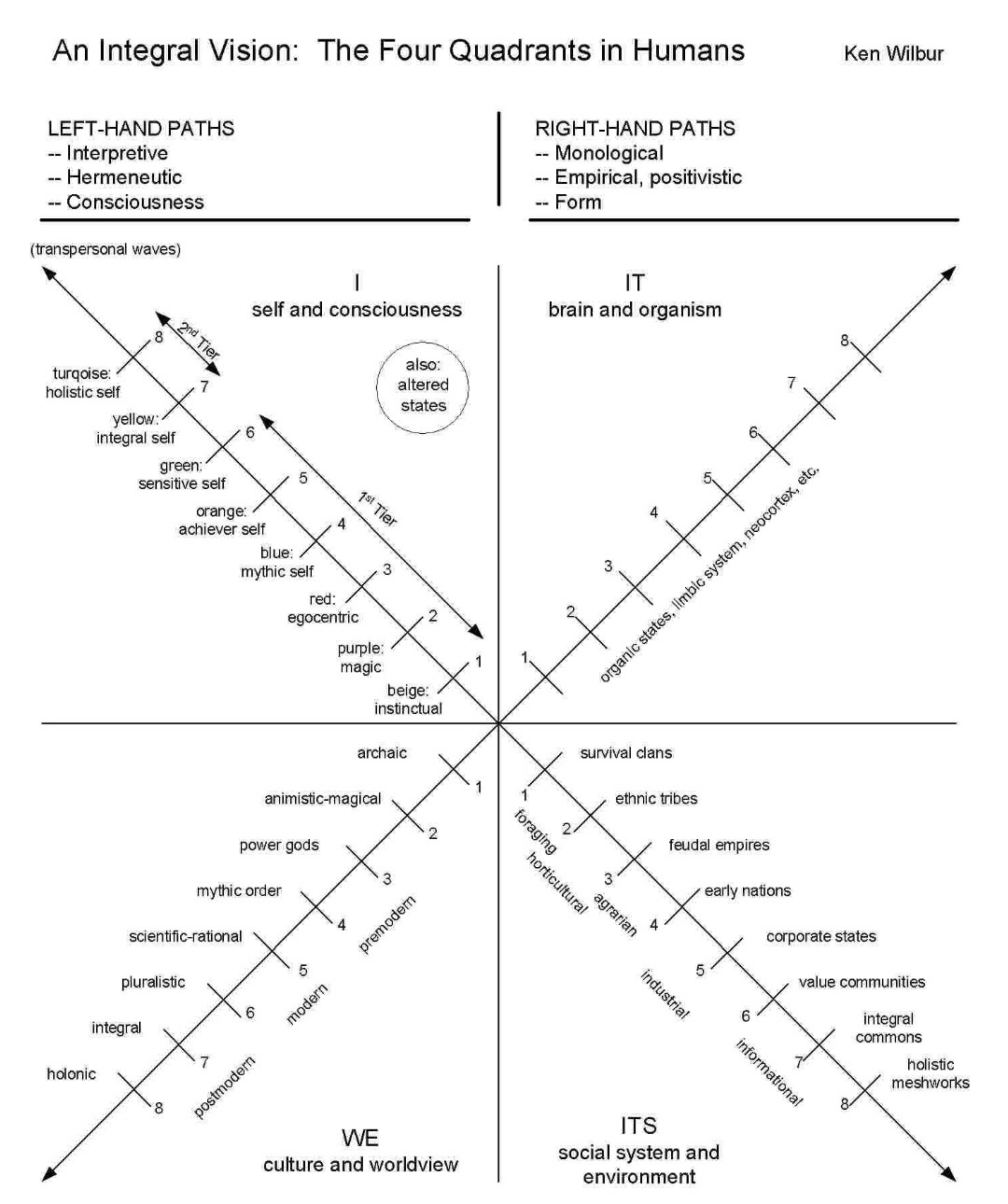
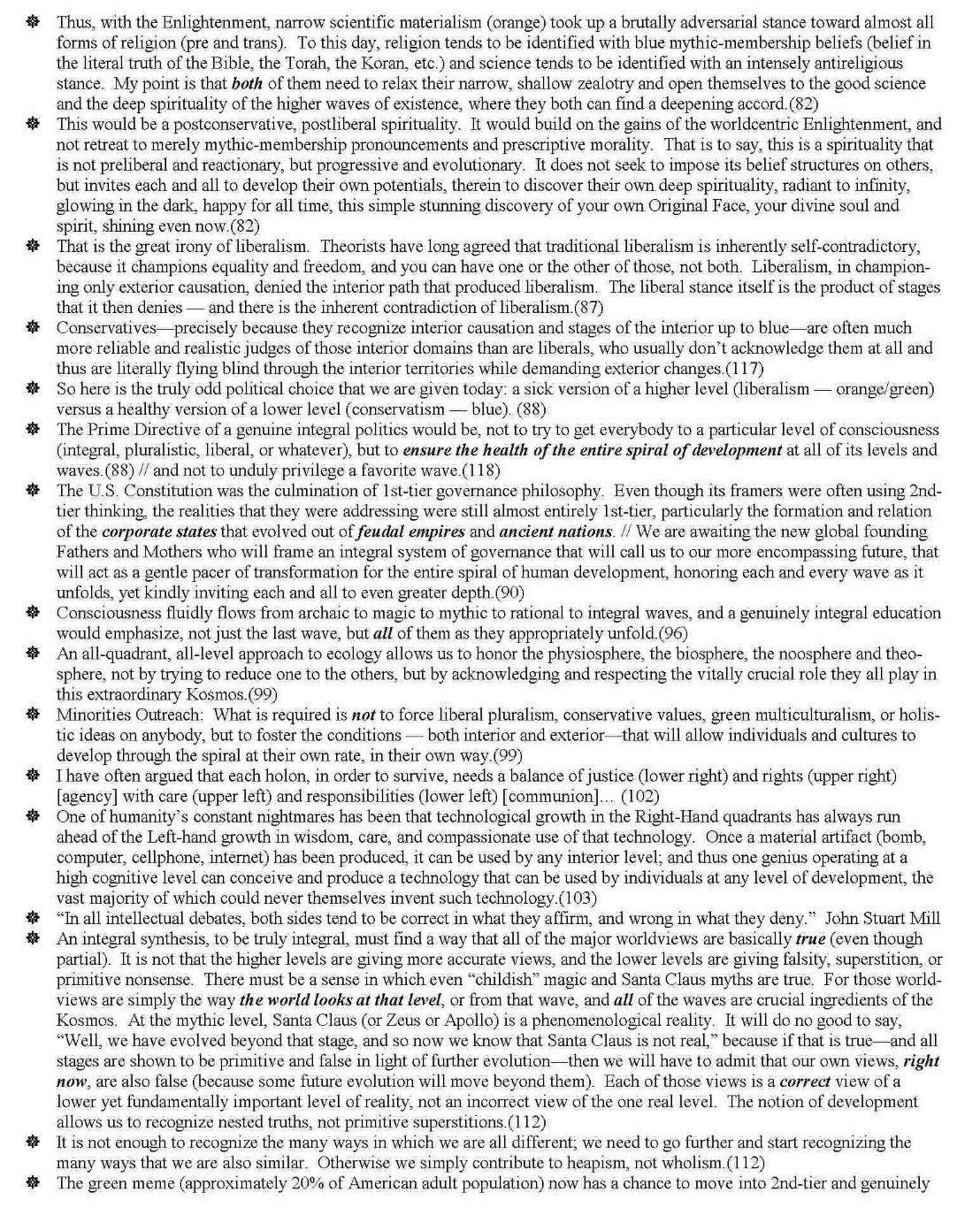

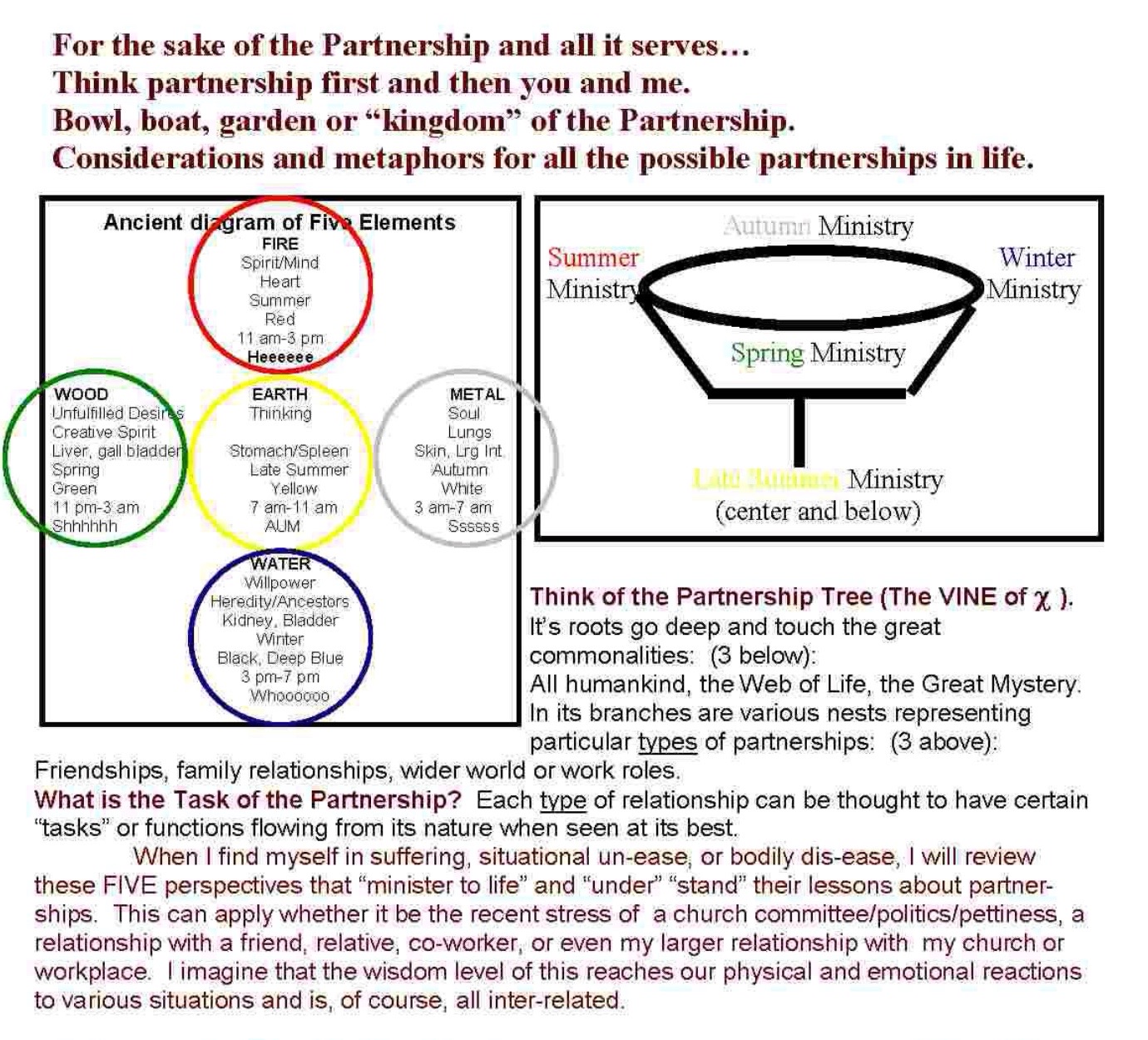
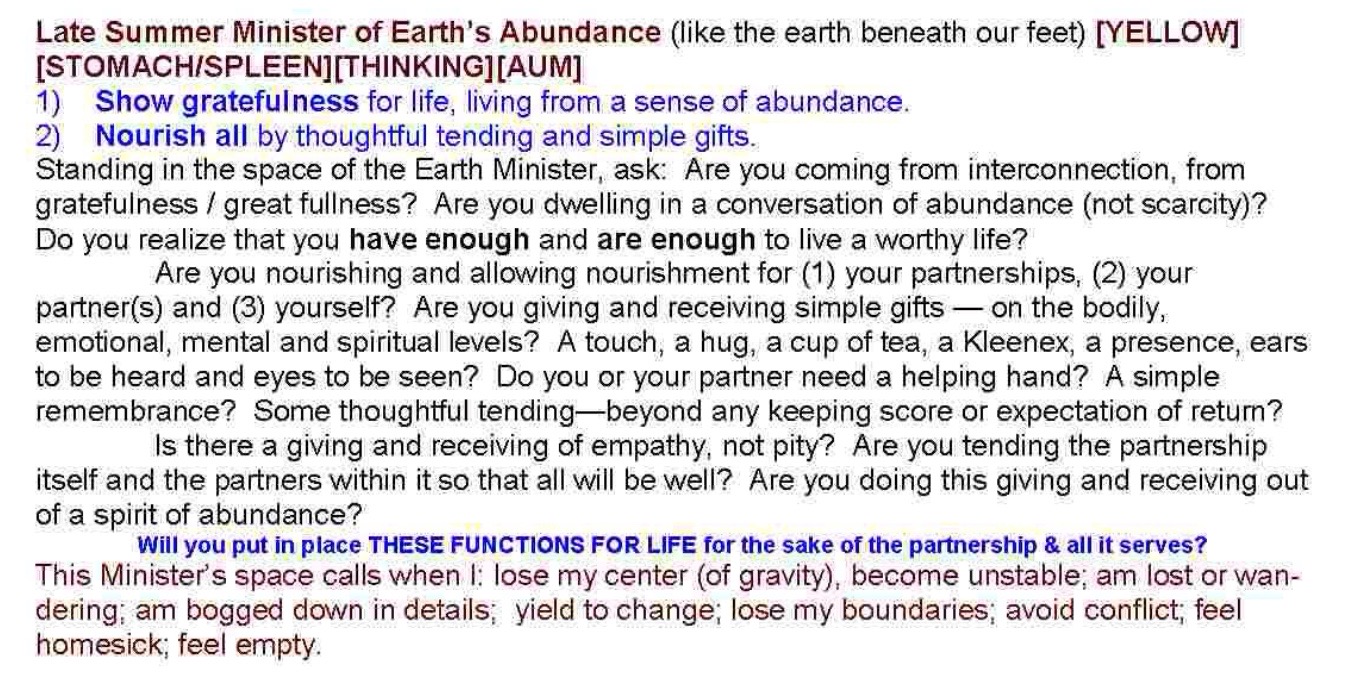
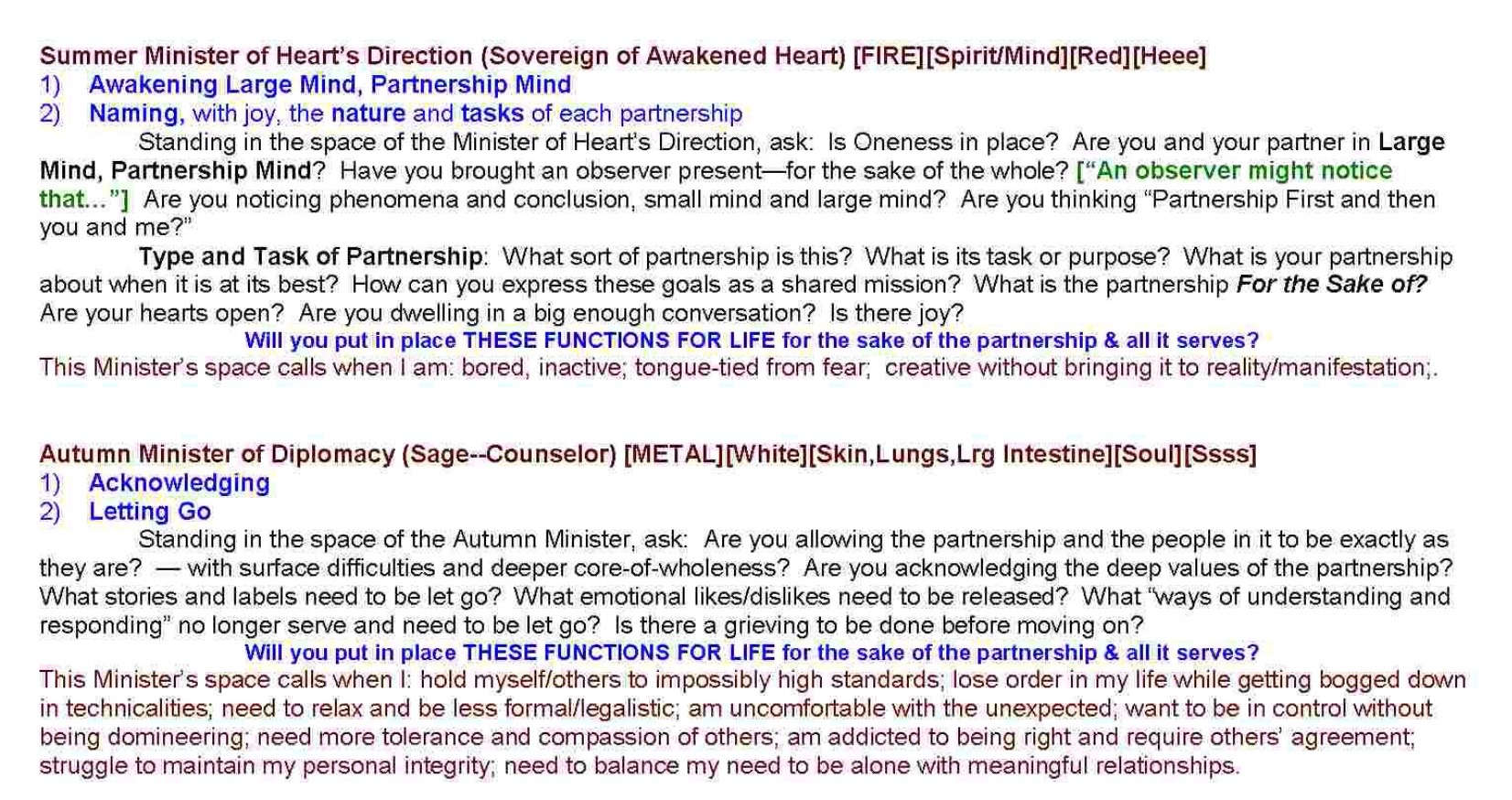
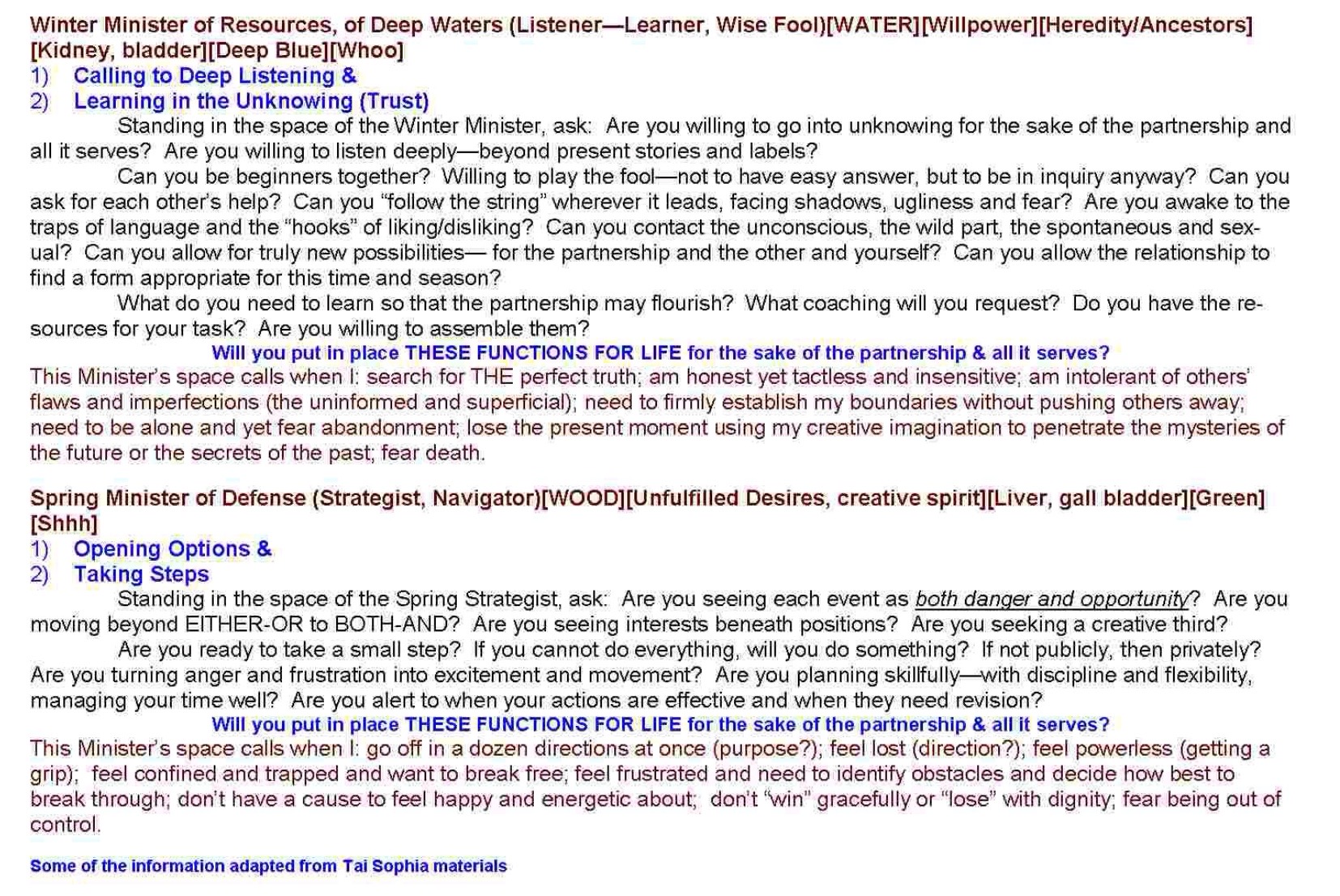

The Jewel Tree of Tibet: The Enlightenment Engine of Tibetan Buddhism by Robert Thurman
Notes from listening to the tapes…
First Scale in the arpeggio: To the Mind of Transcendence (Self-release) Four notes.
1. Appreciate our precious human life endowed with freedom and opportunity..
2. Death — impermanence — don’t know when. Open spiritually to the possibilities of the moment.
3. Inexorable causality — infinitely flowing from past through present to future. Each moment is intinitely pregnant with potential.
4. Inadequate state of suffering (samsara) of ego-centric self state pitted against the over-whelming odds of the universe of “others.”
The Mind of Transcendence removes the pressure of needing ot accomplish. Provides relief.
Second Scale in the arpeggio: The Spirit of Enlightenment: Mind of Love and Compas sion for All Beings. Five notes.
- Equanimity — friends, strangers and enemies. These are as they are mainly from how they have repeatedly interacted with you. They have switched positions over the eons.
- Recognition of motherhood of all beings. Infinity of interconnectedness of all beings.
All have been our mother in the infinity of past existences in the continuity of spirit. No
beginning. No end. No First Cause. - We remember the kindness of these mothers and have Gratitude.
- We repay that kindness wherever they are. We want ot be the mother of their re-birth into infinity-hood.
- We become concerned for them — not our self preoccupation. We choose other preoccupation.
Third Scale in the arpeggio: The Quest of Liberation: Mind of Transcendent Wisdom. Self-lessness of subjects/persons- subjective.
Self-lessness of objects – – objective
Five Notes
- Look ot see what our self would be during righteous indignation. Notice the solid sense of presence. I’m the one. I exist.
- If we look with all our effort and the absolute, separate essence of Self doesn’t exist, then we will admit that.
- Look for unity of ”solid self” and life systems. Find a state of floating free — relative existence.
- Look for solid/absolute self as a process. There is no “tableness” in a table. All dissolves under analysis.
- Space/Nirvana. Emptiness is like the reflection of a mirror — not real. No ultimate state. Stop seeking escape from relational states. Relative states are the absolute state
Freedom is the womb of compassion.
Tibetans and Buddhists were the supreme knowers of nature — done through internal means — rather than external means
(microscopes, atomic energy, etc. like Western scientists). Self-lessness — no absolute self — instead we have a relative self which is the product of our imagination and the imagination of the world /others.
Realization of self-lessness (emptiness). We have an instinctual miss-learning that “I m the one…
This can’t be dislodged by spacey meditation of not thinking. It is an unconscious self-habit and self-knowledge. We add many more layers of “I’m the ______ (man, father, fat, poor…) on top. The whole structure begins to appear to have absolute substance and reality to us.
Royal Reason of Relativity
All things are empty of intrinsic/absolute essence, because they are a relative — since we relate to them.
Absolute has no limits or boundaries. It is infinite. [In physics, “absolute” is only a subjective view point from the self- observer. All other viewpoints are relative to the observer.]
How do we reconcile the different viewpoints?
- Intrinsic “knowing” that “I” am absolute versus
- The logical observation/learning that I am only relative. Through meditation:
- Shamata one pointedness focus/concentration. Shutting off internal dialogue. Instinctive self remains.
- Vipasana — like a koan — dislodges self-centeredness. Merge the feeling of intuition (self-centeredness) with the critical relative-self — using concentration until the self-centeredness is broken through. Drill down with the focused concentration.
Science once was a branch of philosophy studying the Na- ture ofreality.
Vow of Bodhisattva
I dedicate my life/existence to reaching buddhahood so that I can bring all sentient creatures to buddhahood and out of suffering.
Non-duality: emptiness,relativity
Duality believes in a separate state (Heaven, etc.) where the Absolute Self can hide safely from the pain of relationships.
Reality is freedom, bliss. Keep looking deeper to see and know it.
Mirror wisdom — seeing “crap,” we see freedom and bliss.
Tantra means continuity. Once you have demolished the world of absolutes based on ignorance, critical wisdom moves to develop a world shaped by wisdom — a world with optimal opportunity for each being to develop.
To rebuild the world of wisdom, we need the Mind of Transcendent renunciation. Recognizing the infinite continuity of life and appreciating my human sense of that life.
Our only enemy in the world is our feeling of a solid, absolute self. Dethrone that master by understanding that no absolute thing can be experienced by any relative thing. Any sense of person that I have is relative only — therefore it is constructed — made up of experiences. Infinitely transformable, malleable. Impermanence. I am never stuck in any sense of self. We imagine our selves and can do so in creative new ways — moment by moment.
“Death” = un-intwining the soul from hte absolute self. Can be done often with lucid dreaming, imagination, etc. in one physical lifetime. [Apostle Paul said ” I die daily.”]
The intersections of the imagination of sentient beings are what shapes reality. Once everything is void, “nothing” does not exist — and those things that exist are shaped by mind.
Mind is channeled in shaping things because its not a single subjective mind — it’s an inter-subjective mind of many beings. These shape the world through language — through the Word. Mantra — magically gives Form to things.
People feel trapped in “prisons” of steel made of habits and absolutes/ignorance (“that’s just the way it is.”) when they are really only within a bubble of bliss.
Tantric States of Consciousness
Buddhas can consciously build everyday forms from these deep levels.
Transparent light; Dark light; Sun light; Moon light; Candle Flame; Firefly or sparks; Smoke; Mirage/hallucination; form in ordinary reality
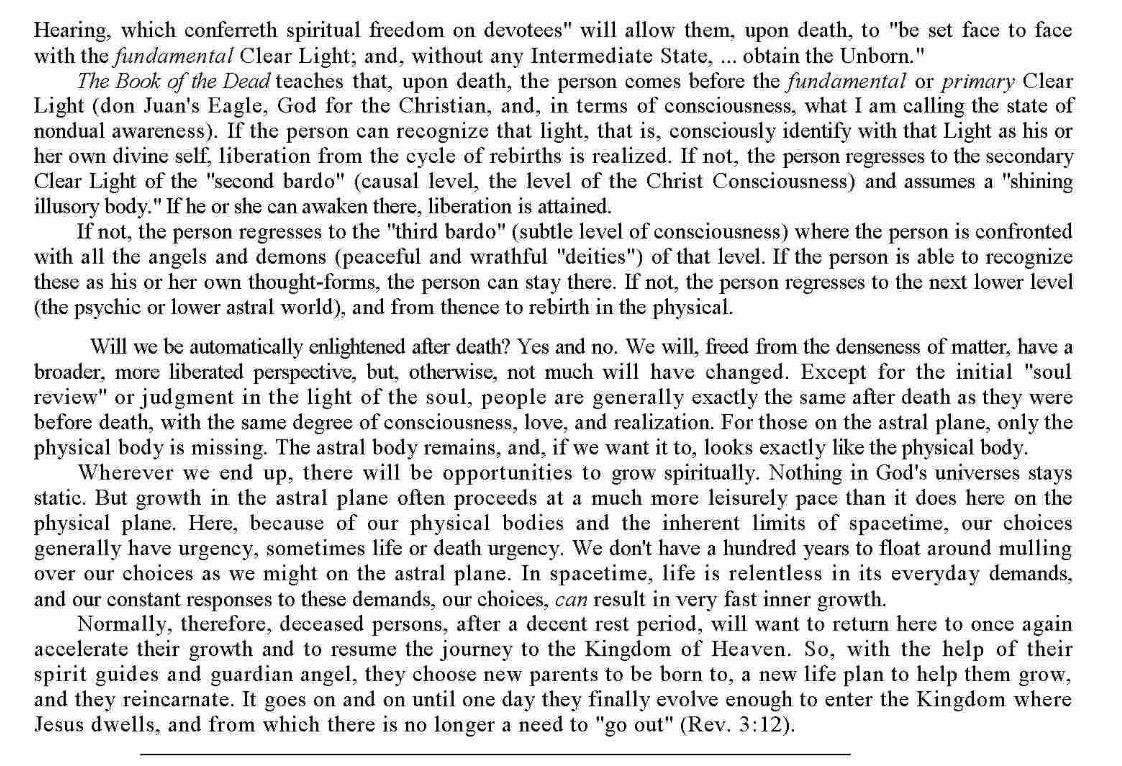
These levels are described in the Tibetan Book of the Dead as levels we move among.
Tibet does not revere ancestors since “to them” there are no dead. My deceased uncle immediately became someone else
— someone I may meet on the streets. Thus reverence for ancestors is transmuted into reverence for fellow humankind.
Om mani padme hum
Tibetans pronouce:
Ome mah’ nee pay may home
This mantra sends relief up and down as needed. To the hells
of heat, it sends cooling. To the hells of starvation, it sends food. Etc.
How to Know God by Deepak Chopra (excerpts)
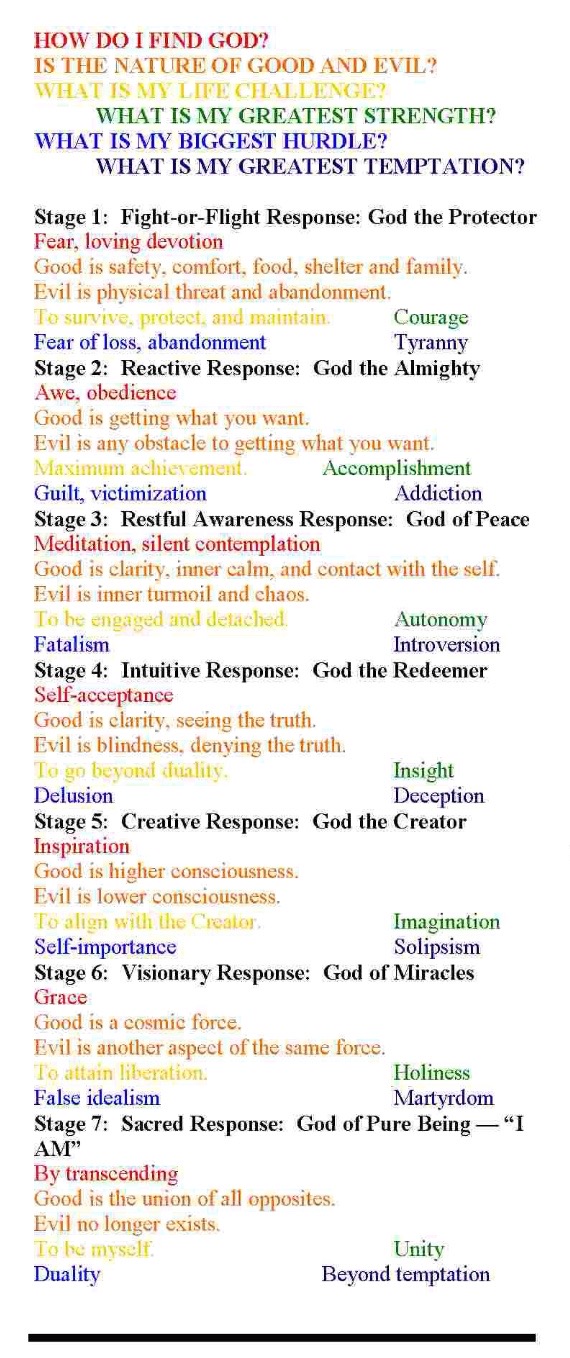
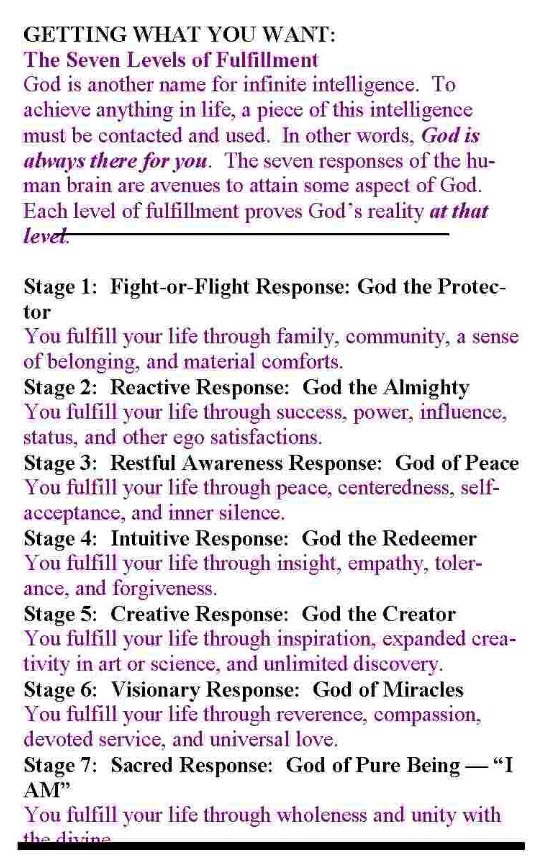
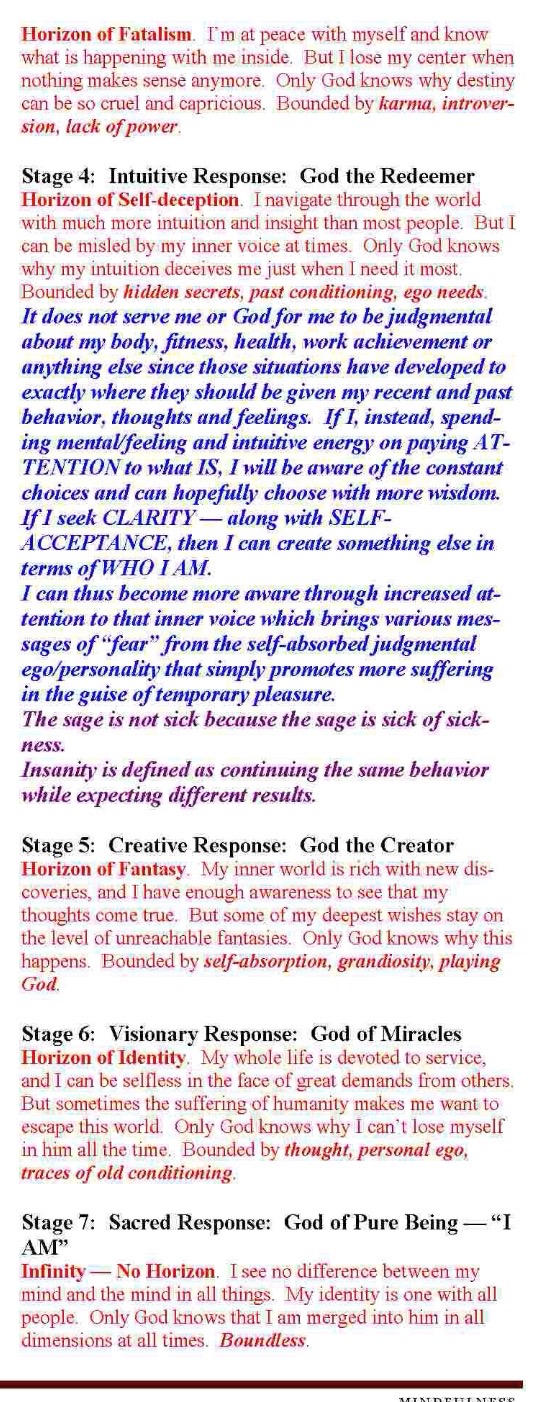
In stage six it is no longer necessary to seek God, just as we do not have to seek gravity. God is inescapable and constant. Sometimes he is felt with ecstasy, but just as often there can be pain, anguish, and confusion.
This mixture of feelings reminds us that two entities are coming into conjunction. One is spirit, the other is body. 147
If God is like a force field in stage six, grace is his magnetic pull. Grace adapts itself to each person. We make our choices, some of which are good for us, some bad, and then grace shapes the results. 148
Karma means always wanting more of what won’t get you anywhere in the first place. 166
Your enemy is not evil but lack of attention. The various practices known as prayer, meditation, contemplation, and yoga have been highly valued over the centuries because they sharpen attention and make it easier not to miss the clues to spiritual reality. A spiritual person is a good listener for silent voices, a sharp observer of invisible objects. These traits are more important than trying to act in a way that God would reward with a gold star. 196
What’s the one thing you can do today to grow in spirit? Stop defining yourself. Don’t accept any thought that begins “I am this or that.” You are beyond definition, and therefore any attempt to say “I am X” is wrong. You are in passage. You are in a process of redefining yourself every day. Aid that process, and you cannot help but leap forward on the path. I/ Our love is bound up with hatred, our trust with suspicion, our altruism with selfishness. Because this is so, the only clear path to God is a path of constant self-awareness. You must see through your own mask if you want to take it off. // A belief lies close to the soul. It is like a microchip that keeps sending out the same signal over and over, making the same interpretation of reality until you are ready to pull out the old chip and install a new one. 199
Because the whole notion that you are a fixed entity is a great illusion, and the sooner you see how varied and complex you are, the sooner you will drop the masks of your ego. 202
In order for a packet of energy to appear, to be seen by the eyes as photons, it doesn’t suddenly jump into material existence. Between the void and visible light, between darkness and things you can see and touch, there is the quantum layer. This level is accessible to our brains, which are quantum machines that create thought by manipulating energy into intricate patterns. 205
I used my brain to make this journey, or at least to begin it. But it wasn’t my brain that recalled his telephone number, any more than my radio contains the music I hear in my car. // It is my belief that the brain is the last stop downriver, the end point of impulses that begin on the virtual level, flow through the quantum level, and wind up as flashes of electricity along the trunks and branches of our neurons.
When you remember anything, you move from world to world, maintaining the illusion that you are still here among familiar sights and sounds. 214
Our minds are a vital tool in the search for God. We trust the mind and listen to it; we follow its impulses; we rely on its accuracy. Far more than this, however, the mind interprets the world for us, gives it meaning. To a depressed person the sight of a glowing Tahitian sunset mirrors his sadness, while to someone else the same signals to the retina may invoke wonder and joy. As Penfield would say, the brain is recording the sunset, but only the mind can experience it. As we search for God. we want our interpretations to rise even higher than our minds can take us, so that we might understand birth and death, good and evil, heaven and hell. When this understanding extends to spirit, two invisible fields, mind and soul, need to be connected if we are to have any confidence in them. 218
The problem is always fear of the intense emotions that occur at the mystical level. Experiences so real and profound that we cannot easily comprehend or accept them… Another way to describe our blocks is to say that we don’t want to change our priorities, nor our beliefs about ourselves and God.” [Dr. Valerie Hunt, Infinite Mind, 1989] The mind field, it seems, is a mine field. 219
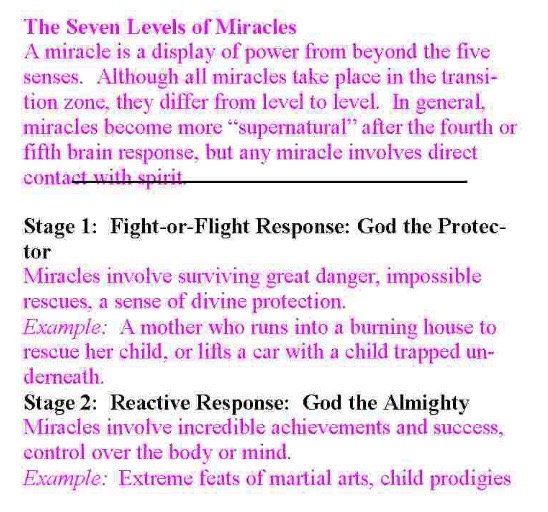
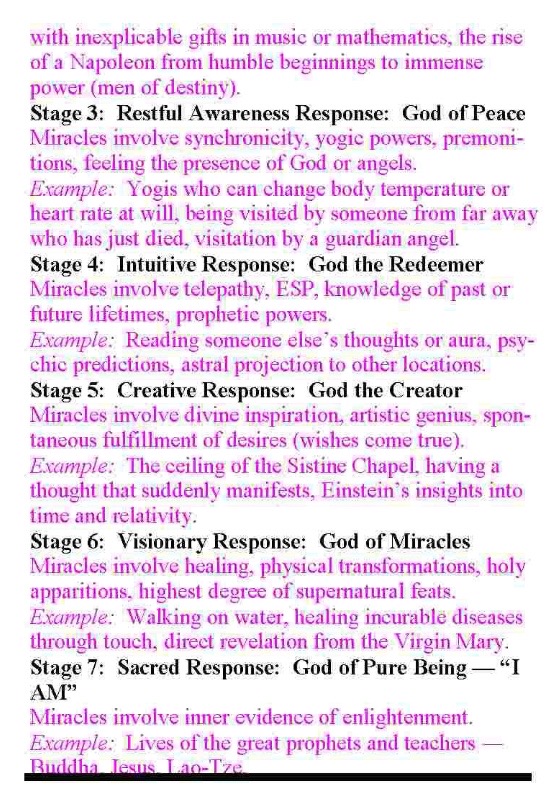
A person with plantar fascitis, had become increasingly in pain from continued stoicism and only sporadic attempts to do some suggested exercises. In desperation, he limped in to see a Chinese healer. The very unremarkable looking healer felt his foot and then made a few signs in the air behind his spine — without touching him. When he stood up, his pain was completely gone! The healer said that the body was an image projected by the mind, and in a state of health the mind keeps this image intact and balanced. However, injury and pain can cause us to withdraw our attention from the affected spot. In that case the body image starts to deteriorate; its energy patterns become impaired, unhealthy. So the healer restores and corrects the pattern — this is done instantly, on the spot — after which the patient’s own mind takes responsibility for maintaining it that way.. After the person continued to walk around in amazement, the healer told him casually that he could be trained to do the same sort of work. The person asked what would it take to accomplish something like this? The healer answered, “You only have to discard the belief that it is impossible.” 222 [summarized]
Now I realize that it isn’t the miracle that creates the believer. Instead, we are all believers. We believe that the illusion of the material world is completely real. That belief is our only prison. It prevents us from making the journey into the unknown. To date, after many centuries of saints, sages and seers, only a few individuals can open to radical change in their belief system, while most cannot. Even so, our beliefs must eventually shift to conform to reality, since in the quantum world, belief creates reality.
As we will see, our true home is the light, and our true role is to create endlessly from the infinite storehouse of possibilities located at the virtual level. 223
Material level. Quantum level. Virtual level (spirit)


Circling the Sacred Mountain: A Spiritual Adventure Through the Himalayas by Robert Thurman and Tad Wise
Excerpts from Circling the Sacred Mountain
An interesting meditation: (p 59)
Settle into a meditation state. Calm yourself by focusing on your breath. Just breathe – count ten inhalations. Once you’re calm, begin to visualize. Imagine a field of vision up above your forehead, which you see with your mind’s eye, your third eye, rather than with your normal eyes — a kind of space and light, a boundless sky. In that sky is your greatest mentor. It could be some great teacher you had in school, a parent, or a grandparent, Jesus Christ, the Buddha. Whoever the person is, whatever the religion, it doesn’t matter; the race, gender, and era don’t matter. Choose him or her to embody the state of being that you aspire to — enlightenment, the total knowledge of everything worth knowing.
Visualize that person present there before and above you as a body made of light. Now the being looks at you, and you see the face — it’s hard to visualize whoever it is, at first. It’s just a flash, because your mind is unsteady. You see that being up there above you — I’ll just use Jesus Christ because that works for me — right here, not dead two thousand years ago, and he’s happy that you’re going to meditate now. He’s looking down at you, smiling because you are concentrating on opening your mind, and from his smile light rays flow down. Like streams of medicine, they flow into you and make you feel more light. You begin to feel blissful and buoyant, as though a spotlight is shining on you, lifting you up in this spiritual limelight that makes you glow with bliss. It drives away smoky, dark doubts, negative attitudes, and worry. Visualize that you’re being bathed in this radiant aura emanating from a being of total omniscience. It takes a lot of imagining. Don’t forget to breathe — you must breathe to imagine. At least in the beginning.
It is crucial to develop this positive setting before meditating on anything. A luminous setting is the key to lifting ourselves out of our habitual ruminative thoughts, our sense of self-identity, our self-world. We need to enter into the space of saints and sages and gods and goddesses and create anew space of possibility for ourselves. We don’t just say: “Well, I’m going to do something, but it’s going to be the same me that does it.” This goes along with the presupposition that after I finish it’ll still be the same “me” who just spent time meditating. Instead we start meditation by creating an ideal space, and then we enter that space and everything opens and becomes possible. This is a path of becoming aware of and then shifting our sense of orientation, substituting a more positive view.
This space where we take refuge when we meditate is known as the refuge field. It is a kind of portable shrine we learn to live with, as we make our lives more and more spiritually positive.
Now fill the field around you on your level with a great crowd of beings below the luminous presence. These beings cannot see the enlightened beings above, since they are not consciously seeking refuge, but they can see us. In the front ranks of this crowd are all those we know closely — our lovers, our mates, our children — looking to us because they sense that we’ve entered a different field. They perceive the light that suffuses us from the mentor-being as our own new glow. For this reason they’re smiling too. Their pleasure manifests in more light and energy flowing back to us in turn as more empowerment, more energy and encouragement.
From the mentor-being to us, to the other beings, back to us, and back to the mentor, a figure-eight circuit flows. We sit at the central point of the figure-eight. We’re not just developing in isolation, we’re beginning a conscious evolution in relationship with all those around us.
When you get a little more stable in this meditation, you try to include people you don’t care about, and then even people you dislike. But don’t try that right away or it’ll put you in a bad mood. Instead work on creating this figure eight of light and love. Cultivate this field of bliss, which you have earned through much evolutionary struggle. Sense the incredible preciousness of this accomplishment. Feel pleased with yourself, soberly impressed with what you have achieved. You don’t need to adopt a completely different belief system as long as your old one allows you to feel that you are precious. So hold that thought. Proud, pleased, and happy, glowing with energy.
Without leaving the refuge field, we turn to our next theme, impermanence. Right away we address death, reflecting upon how transitory life is. We know very well that some of our plans may not come to pass. We have no idea at what time we actually wil die. Sure, we’re going to die. All beings die. Therefore, we meditate upon what are called the three roots of immediacy.
The first root is the certainty of death. Death is instantaneous when it happens. It’s the withdrawal of your awareness from your senses and your body, your consciousness shoots out into a dreamlike state. Developing a strong certainty that we are going to die liberates us from unfocused practice.. It dawns on us that this body and mind and these five senses will cease to be.
The second root is the uncertainty about when we will die. Often children die before their parents, well people die before sick ones, a person in safety dies before one in danger. There is no certainty. The causes of life are few and they are fragile, the causes of death are many. We habitually go along secure with the idea that there’s going to be some time later when we’re going to die, “when you are old and full of sleep,” but there is no knowing when.
The third root is the certainty that when we do die the core of our being is what we will take with us: The Dharma is the only thing that will help us. Our bank account will not help us at that time; our muscles, our nerves, our skin will not help us at that time; our organs, liver, heart, none of that will help us at that time; our eyes, ears will not help us at that time; our friends and relatives will not help us at that time; our course beliefs, our factual knowledge will not help us at that time. The one thing that will help us at that time will be how much of the Dharma we have integrated into the core of our being: our openness, fearlessness, tolerance, generosity, intelligence, calm. That’s what helps us confront death. It’s all we can take with us.
If we neglect the deep core of our being, it shrivels. If we are intolerant, clutching, not generous, with no concentration, then we’re going to be in trouble when we die. The only thing that will help us is what we have invested within. While meditating on this third root, take an inventory of your life. Realize that you’re spending 95% of your time strengthening your body and making it healthy, spending money on medicine, earning money to pay for clothing, medicine, food, face lifts, cosmetics, vitamins. You pamper your body of this life although after death it will turn into garbage. You make huge investments in possessions and property, none of which will belong to you in the future. Someone else will be signing the checks. The government will be taking its inheritance tax. The kids will be blowing it on this and that. And yet we spend 95% of our time on these things we can’t take with us. What a waste!
From the three roots grows our awareness of impermanence, of the immediacy of death. We come to feel that there is no time at all. We become alert to the moment, making the moment as full as possible, because we’re not investing it in some other thing. We don’t know what could be happening next, so we concentrate on what is happening now. This kind of awareness. held in creative tension with the preciousness of human life, is extremely liberating.
Concluding, look up again into the spiritual sky above you. Your mentor or mentors, he or she or they, are delighted that you’re reflecting on these deep themes. Their pleasure at your understanding flows toward you as a cascade of nectar. The mentors themselves actually dissolve into light, flow down, and come to rest in the center of your heart. Their own life stream merges with yours.
Before we break the meditation we cherish a last taste of this nectar. Their luminous energy has filled our hearts; we arerenewed and refreshed. We must also remember gratefully to dedicate the merit of this practice for the sake of all beings — all those we have gathered around us and all the others behind them. Whenever you do something good, you should never leave it just by appropriating it to yourself. That would lessen the positive impact. You should right away invest the positive achievement — the merit — in the larger good of the world. This multiplies the good immeasurably. So in order to dedicate whatever merit we have created here today, we resolve to become perfectly enlightened buddhas so that we truly can become a mentor for all beings, to help them reach their own full potential, their ultimate freedom and happiness.
The trick is to get that infinite bliss and be totally present here in all this concreteness! That’s the real trick, that’s buddhahood. 64
The mind of immediacy is not a morbid mind. It is a liberated mind. All that’s inconsequential drops away, you see? But you have to really reflect on your own death, that that’ll be it for this life of hopes an dreams. You get all tortured about the great novel you’re going to write and all this. Then you’re going to be done. The novel is going to be dust! The libraries are going to burn down. It doesn’t mean you might not still write the novel, but you relate to it in a very different way. You become more immediate about the process of writing.68
We come now to the Buddha’s first noble truth, the noble truth of suffering. People first hear of this theme and think it’s the morbid invention of a killjoy. But it’s not gloomy; it’s merely realistic, a method of evaluating “what is our actual experience?” First we notice how difficult it is to even steady the mind to make such an inquiry, for our internal monologue is constantly demanding, “How can I feel better?” Constantly thinking:”When Iget there, then I’ll feel good.” “When I wake up tomorrow I’ll feel good.” “When I have this food, that thing, that relationship — then everything will be all right. “72
We’re habitually out of balance, and all of our experience will inevitably be frustrating and unsatisfactory. We have to acknowledge this and accept the fact that we’re off balance. We’re simply not going to find happiness, the way we’re facing our situation, feeling ourselves alone and struggling in an alien world, trying to get the better of it. Once we’re set apart in this way, in the battle of self versus the world, the self has got to lose. The world is bigger and stronger; it’s inexhaustible, while we get tired so easily…
When you meditate on this carefully and thoughtfully, you begin to feel genuine sympathy for yourself, you begin to excuse yourself from chasing your illusions. 75
Turning to the second noble truth, the noble truth of causation, you begin to analyze the self-versus-the-world structure itself, since it’s clearly the cause of all the suffering….
Ignorance, which is the fundamental self-construction, or better, missknowledge, the habitual assumption of being a
separate, independent self, this is the root cause of all suffering, according to the insight of the Buddha…This is the first primal reaction of the alienated self — desire, greed, and attachment. When the world won’t give itself over to you, when it even comes to take things away from you, then you feel fear, anger, and hostility — the second primal reaction of the alienated self.76
Knowing that the causal pattern of evolution is inexorable on the relative level helps you avoid both the irresponsibility of reckless activity and the hopelessness that arises, from the fear of losing the positive results of good activity. 76
Once we feel compassion for ourselves we can allow ourselves to abandon compulsive pursuits. The immense relief we get from that abandon enables us for the first time to look at others and begin to feel real compassion for them. To develop this compassion, it is first necessary to realize that we don’t now feel real compassion for others. This can be a bitter pill, but when we examine ourselves we soon encounter a being so caught up in thinking about itself, in wanting happiness and not wanting any suffering, that not much attention is paid to others. We don’t really care deeply about others, except in rare instances when we are in love or in some other exceptional state. Being habitually preoccupied with ourselves, we don’t easily put another’s life-pulse ahead of our own. 92
Realizing this, we soon discern that the source of the like and the dislike is not something intrinsically objective in the person. It’s actually in my reaction to their pleasing or displeasing me. 93
Once we have impartiality as a foundation, we can begin with the first of the Sevenfold Causal Precepts, 1st Precept is known as mother recognition. This meditation is premised on the infinite past lives of ourselves and others… //seeing all beings as our mother. // People start to look familiar, no longer strange. 95
2nd precept is Gratitude. When we meditate on this we should reach the point where we feel so moved by the love of our mother that we become tearful.
3rd precept is Repaying that kindness. 2nd phase of Gratitude.
4th precept is Love. For all our mother beings. see the beauty in them. We can see where they could be happy and perfect. We don’t get caught up in their theater of pain and misery. We love them by seeing their loveliness.
5th precept is Compassion. We look clinically at our mother beings and we realize that for the most part they are constantly batting their heads against various walls, doing the opposite of what would make them really happy. They’re addicted to various emotions, delusions, bad habits. Finally it becomes unbearable that they should suffer so, and we vow: “I will do what I can, I will devote my life to relieving them of that suffering.”
6th precept is Universal Responsibility. Since God has not freed these mother beings of their suffering yet, I must do it. This wild resolution to do the impossible is the actual spark that kindles the spirit of enlightenment, the spirit that makes a being a bodhisattva. In the modern worldview of one single lifetime, saving the universe is an insane goal. But in our meditation, our vow to liberate all beings from suffering is calm and rational. For from the Buddhist point of view, we have infinite lives infinitely entwined with other beings, so we must free every single one if we want to free ourselves. It becomes the natural thing to do.
7th precept is the fruition of the previous six. You give birth to a new messianic soul that is resolved to place the needs of others above the needs of self and to exchange preoccupation with your own happiness for a preoccupation with others’ happiness. 97
Buddha gave an understandable explanation that the reason we don’t so easily love our neighbors is that we are caught in a distorted perception about the centrality of ourselves as fixed, independent, isolated entities apart from all others. 110
Then you restore your boundaries and you feel different again. But you suddenly realize that the difference between you and other things is habitual. It’s arbitrary, it’s relative. There’s no absolute difference between you and other beings. 116
The chief enemy who has been forcing us into one suffering after another is this self-preoccupation habit, which we have had since we were animals. 127
You focus on yourself and constantly think: “What can I get? Where do I fit in? Are they doing what I want? Are they meeting my needs?” These attitudes are the sputterings of the demon self-concern, the bars on your prison walls. 129
We begin with facing all the negative things that happen to us, finding the way not to let them bind us into negative-reaction cycles but turning them to our advantage instead… The first step is to take responsibility for everything bad that happens to us and not to project responsibility out, in order to use all our energies to evolve ourselves internally rather than to vainly struggle with the environment.145
“Henceforth I’lI only use positive perception.” This refers to an internal revolution. It doesn’t mean you annihilate your critical faculty. Everything is void, so everything is relative. Relative reality is fluid and not fixed, being simultaneously ordinary and extraordinary. It is multifaceted and ambiguous, easily provoking cognitive dissonance.
The purpose of practicing positive perception as mind reform is to stop blaming everybody else in the world, to stop seeing faults as others’ problems, and to take all faults upon ourselves. This empowers us to do something about ourselves and to take responsibility for our future and for the world. ..// We must change our habitual way of justifying our own faults by blaming the world into a new discipline of seeing our faults as causing our problems. Then we can use the energy from this challenge to eliminate our faults within. 148
The Blade Wheel states that “obsessed with pleasure we drown in suffering.” 156
I can change the past, by purifying the present and polluting no more… // Sin is what interferes with the infinite. Sin is what intervenes and blocks the figure-eight circuit, breaking us up…// All outward enemies would be seen as manifestations of old business. Suddenly nothing outside me can harm me, because I refuse to acknowledge the old border of me. There is no secret weapon anyone or anything can pull on me. For the smoking gun always comes from my own holster. 158
When we suffer natural disasters, instead of bewailing our fate, we reflect that our own unethical conduct and vow-breaking exposes us to this type of thing. At first they seem to come from nowhere, we don’t deserve them, and we feel out of control; but we can regain leverage if we recognize our own failings in the past as underlying causes.
Buddhists think there are angelic beings powerful enough to avert storms or divert floods. What happens to us is never a random accident. We can embrace even a natural disaster as a circumstance and an opportunity to renew our energy and intensify our spiritual development, rather than simply complaining in vain. We learn to consider even thoughts as significant deeds, causing effects far beyond the subtle medium of electromagnetic energies in the brain, in order to develop the subtle mindfulness about negativities within us even at the most subtle level. Mind reform involves radical attitudinal change, requiring that we not waste our primary energy struggling with external reality, but focus it internally in ourselves where we can become the masters rather than remain constant victims. This does not mean we should do nothing about external circumstances, just that we should keep our priorities straight. 170
With a little effort of critical thinking, we can go beyond this and realize that this moment itself is infinite. Within this moment are all the qualities of all of our past and future lives. It is like Nietzsche’s eternal recurrence: Everything we do we should be willing to redo for eternity. Everything we do reverberates for eternity, so we should live in ultimate concern for the quality of our living…// We should live in the infinity of the moment and find the power of taking responsibility for infinite consequences. // “Henceforth I’lI control myself with real love of freedom.” That freedom, the true sense of the infinity of the moment, is right here now. 173-4
So we need to intensify detachment to overcome our enemy of self-addiction. // Far more harmful than Mara the Tempter, is the devil of self-addiction each of us carries within us, mistaken for our very self. 174
Let’s be kind, let’s be happy, and let’s accept others’ kindness on the crown of our head. 175
“Mindful’ means we must know the subtle details, the little ways that have allowed each tiny bad motivation to creep in, because each has a huge negative effect. // The notion that the ultimate or nirvana is some place into which you float away is based on your flawed sense that you are a separated thing who could withdraw into the inner room of your falsely absolutized self. This — the delusion that we are or can be separate from the world is the source of all negative things. Nirvana is this world as experienced by an altruistic being — a truly other-preoccupied, infinitely expanded being — and so enlightenment means super-mindfulness of minute facts and minute consequences, not an awareness that is just blown away and collapsed into nothingness. 176
When we feel ready to gain the energy necessary to achieve the infinitelv positive, we have to be open to a healthy fear of the danger of the infinitely negative (hell, evil). 176
Enlightenment is the ultimate tolerance of the cognitive dissonance that grips you when you confront absolute and relative at the same time. Enlightenment is being simultaneously totally present to the relative and totally liberated in the absolute. Buddha is totally out of here, in nirvana, where nothing bothers him. At the same time he’s totally present here, concerned for all beings. 189
the four(?) remedies: remorse (You must genuinely acknowledge the evil things you have done. Really face them.), repentance, resolve never again to be the slave of the self-preoccupation habit, and the wisdom of voidness (really there was no reason to have done them, they’re not ultimately there; that’s where you break the chain). Repentance alone, as it tends to reinforce your sense of the concrete reality of the sin, is not enough. Ultimately, you have to see through the sin. When you truly see its voidness, you can break free, and then you really will never do such things again. 190
The relative self is the living self. When we get rid of the delusory overlay — our sense of a rigid, absolute self — we are released! Then our relative self at last becomes a buddha-self. This is what selflessness is. It does not mean you throw away, suppress, or destroy your ego. Understanding it strengthens your ego and liberates you. Buddha is smiling not because he wants people to commit psychic hara-kiri, but because he sees that it’s possible for people to get rid of the erroneous sense of absolute self. You’re simply getting rid of a delusion, you’re not getting rid of yourself. 191
We are also working on taking that little triumph in the day when you get rid of your self-involvement and just release yourself into your play or work. You get free of self-constriction and enter the zone of power. 193
…formula is that evil is infinite, but goodness is infinite squared — infinite times infinite. Because the infinite evil beings draw energy from their self-addiction, each works for one person only. But the infinite good beings draw energy from love for others, each works for infinite others.104
Now we know that it is considered a great blessing in the West to leave this body in your sleep – not so in Tibet.
Tibetans like to die wide awake. They also meditate with their eyes open. 207
In their ceremonies, the Lakota people say, “Oyatsuke Mi-yasun,” all beings are my mothers. All beings are my fathers. All beings are my relatives. 208
We learn to pretend as children. When a parent had something we wanted, we could be so sweet. As adults we’re still hinting for presents, flattering and stroking people to get what we want from them. Inside, we’re always dissatisfied, always wanting more from those we’re with, never enjoying just being with them. The other side of greed is stinginess with what we have. I hide things, lock them up, and repeatedly check my hoard to see it it’s still there. 210
Nor will I only avoid the stupidity of commission, but that of omission, too. It’s what they call mindfulness, which is the realization that life is a ten-board chess match — and every move does matter.
My self-habit is my jailer, keeping me from really being new, fresh, live, and joyous. But the jailer is just as much a prisoner. 227
This is what differentiates buddhahood from theistic visions of the highest deity, a transcendent being who is outside the world and beyond it and yet somehow inexplicably reaches into it. That illogical possibility that there is a non-relative, absolute being is transcended in the Buddhist philosophy by the concept of nonduality, that a buddha is a being who is infinitely present everywhere in the universe and yet simultaneously totally liberated by being infinite.238
Here the freedom made possible by voidness loosens the chain of evolution and lets us out of the prison of fatalistic determinism. 241
So when we can relate to something that is simultaneously there and not there, that’s when we’ve mastered nonduality. 256
Tantra… It isn’t that there isn’t good and evil anymore, but you use the language of ordinary and extraordinary instead, and you say, “I’m going to transmute the vision of the ordinary into a vision of the extraordinary.” 287
Tantric vows. You see everything as a magical, poetic reality. 304
Om mani padme hum declares that everything is perfect in every atom in every instant, that compassion and wisdom are present everywhere, that love is present everywhere.
Bliss emerges from everything everywhere. There is nothing to fear. Even when it looks like hell in front of me. I can just embrace it and it will turn into a bed of roses. 317
If you develop an inner murmuring like water flowing, your mantra will bring grace and gracefulness to your last stand. A death where the mind easily leaves the failing body and rolls on with the mantra unimpaired. … // It is the heartbeat of the strong love force of the universe.
Once you realize voidness or selflessness, what you realize is that your world is what you imagine it to be, maintained by the shared imaginative patterns of all beings. Your mind is completely intertwined with other beings minds, so we must focus our minds all together to create a better reality. Though it is fluid and subtle, there’s still an objective reality, because there are so many subjectivities other than our own 334
Full satisfaction isn’t addictive, because it opens out into endlessness, leaving you free of craving. Things that hint at satisfaction and then frustrate you become addictive, because you have to keep going back, hoping for better luck next time. 336
Now the saint returns to the marketplace, so focused in her transcendent magic that it persists, unencumbered by the unmagical world because she knows that the ordinary nests perfectly within the extraordinary. 340
 A-Maze in Grace